Motivation
Curiosity in psychology: what it is, and how to use it to learn
 Yusuf DemirciContent Writer at Psychology World
Published 27 Nov 2026 · 9 min read
On this page
Please note
Psychology World is an educational reference, not diagnosis or treatment. If you need help, talk to a doctor or a qualified professional.
Curiosity in psychology is a drive for information. You notice a gap between what you know and what you want to know, and you act to close it, often for its own sake rather than for a reward.
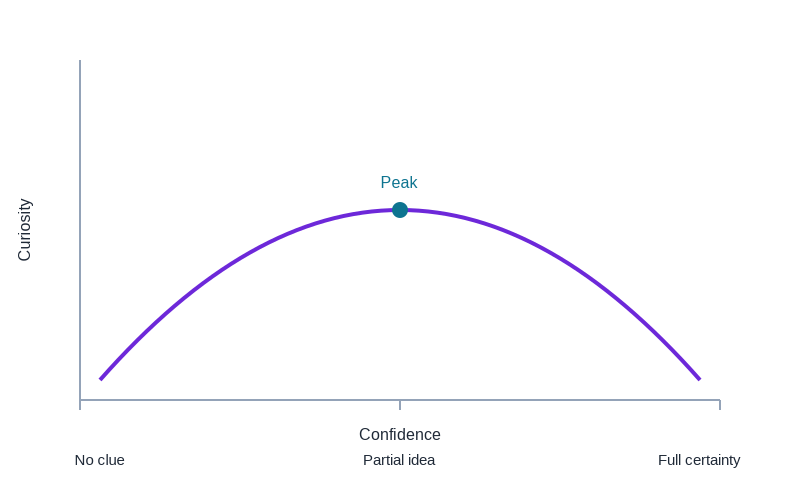
That small gap shapes learning. Questions you partly answer in advance spark more curiosity than questions you know nothing about or fully know. Material of middle difficulty holds attention longest. States of curiosity aid recall, including recall of nearby material you did not target.
This article defines curiosity from the cited sources and sorts its four types with a short test. It states the gap and Goldilocks findings with their limits, and turns them into a question-first routine for psychology terms.
- Curiosity is a drive state for information, present as a momentary state and as a stable tendency.
- Its four types cross two pairs: epistemic against perceptual, specific against diversive.
- A perceived gap in knowledge sparks it; moderate confidence sparks most.
- Curious states aid memory through reward and hippocampus activity, with modest lab evidence.
- A question-first routine turns a flicker of curiosity into a retained term.
Keep the terms from this post
Look them up in Psychology World, save them to a list and study them.

What curiosity is in psychology
Curiosity is a drive state for information. Decision makers seek facts, explanations, or sensations because they lack them, not only because the facts pay off later. Its most cited function is to motivate learning: it steers attention toward the missing piece (Kidd and Hayden (2015). The psychology and neuroscience of curiosity.).
The field treats curiosity both as a temporary state and as a relatively stable tendency. Each of us is capable of curiosity, but what sparks and sustains it varies by moment and by person. People with a strong tendency stay attracted to new people, new things, and new experiences, and they report boredom less often (Ben Dean (2004). Curious About Curiosity?.).
Curiosity is not the same as general interest alone, and not the same as risk seeking. An extrinsic search for facts before a choice counts as information seeking in a broad sense. Curiosity in the strict sense is intrinsically motivated: you want the answer because you lack it (Kidd and Hayden (2015). The psychology and neuroscience of curiosity.). Animals and infants cannot report motives, so observers judge from behaviour, and the boundary stays debated.
The four types of curiosity
Psychologist Daniel Berlyne set the taxonomy the field still uses. He crossed two dimensions: perceptual against epistemic, and specific against diversive (Kidd and Hayden (2015). The psychology and neuroscience of curiosity.).
| Scope | Epistemic: you want knowledge | Perceptual: you want sensation |
|---|---|---|
| Specific: you want one answer | You ask what retroactive interference means and want its definition | A strange tone sounds in a lab and you turn to locate it |
| Diversive: you explore openly | You browse psychology terms with no target and follow what pulls you | You enter a new room and scan its sights and sounds with no task |
Use this one-question test to sort any example. Ask what the seeker wants: a fact or a sensation, one answer or open exploration. A student who asks for the meaning of a term shows specific epistemic curiosity. A child who plays with a toy to see what it does shows diversive exploration. A reaction to a novel flash shows perceptual curiosity.
The pairs often mix in real study. You start with diversive browsing, a term catches you, and the motive narrows to a specific question. Name the mix rather than force one box.
Why a small gap sparks curiosity
Economist George Loewenstein framed it as an uncomfortable sense of missing knowledge: you feel a gap and want it closed (Kidd and Hayden (2015). The psychology and neuroscience of curiosity.). A small dose of information primes the gap. Enough information closes it and reduces further search.
Kang and colleagues tested the gap with trivia questions. They found that curiosity about the answer is a U-shaped function of confidence about knowing that answer (Kidd and Hayden (2015). The psychology and neuroscience of curiosity.). People with no clue cared little. People with full confidence cared little. People with a partial idea cared most, and they even paid to learn the answer early.
The learning effect was particularly strong on trials on which subjects' guesses were incorrect.
Infant work points the same way. Kidd and colleagues showed seven- to eight-month-old infants animated scenes of objects leaving boxes. Infants looked longest at scenes of intermediate complexity, neither fully predictable nor fully surprising. The team called the pattern the Goldilocks effect (Denworth (2024). Hitting the curiosity sweet spot.).
Read the numbers as lab evidence, not as laws. Trivia samples are small, infant looking time is a proxy for attention, and computer models of learning progress simplify real classrooms. The direction repeats across labs, but the exact peak of curiosity shifts by person and topic.
Keep the terms from this post
Look them up in Psychology World, save them to a list and study them.
How curiosity helps memory
Curiosity changes what the brain does before and after an answer. Higher curiosity raises activity in areas tied to reward, including the striatum and its dopamine release. When the answer arrives, activity rises in areas tied to learning and memory, including the parahippocampal gyrus and hippocampus (Kidd and Hayden (2015). The psychology and neuroscience of curiosity.).
Gruber and colleagues showed the practical side. Participants rated curiosity for trivia questions, waited, saw neutral faces, then received answers. Later tests showed better recall for answers to high-curiosity questions. Oddly, participants also recalled the faces paired with those questions better. Matthias Gruber sums the effect up with a vortex image: a curious state drags nearby, untargeted material into memory along with the answer (Denworth (2024). Hitting the curiosity sweet spot.).
Treat the mechanism with care. Reward-area activity accompanies many motives, so it supports but does not prove that curiosity feels pleasant. Face recall is a lab proxy for incidental learning, not proof that everything near a curious moment sticks. Curiosity raises the odds of recall; it does not guarantee it.
How to use curiosity to learn psychology terms
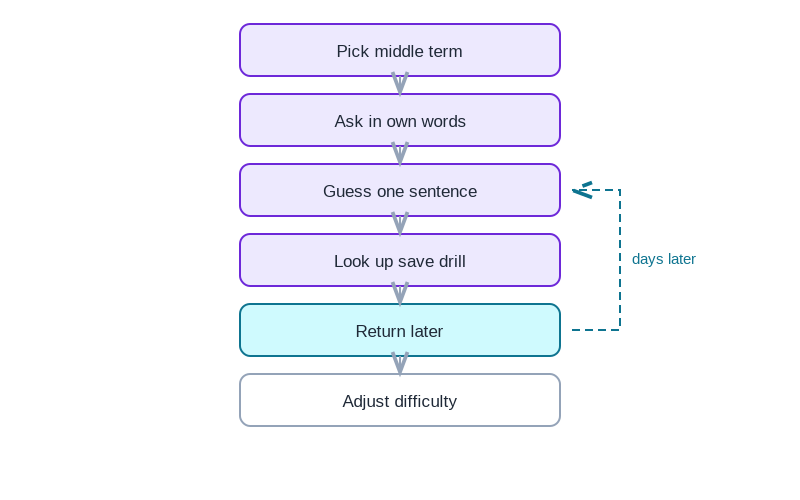
Use the gap on purpose. The routine below turns one question into one retained term. It fits a single study block.
- Pick one term slightly beyond what you know. If you fully know it, pick a harder neighbour. If you know nothing about it, read its first line first.
- Ask a question before you look the term up. Write the question in your own words.
- Guess the answer and commit to it. Write one sentence, then check. Learning is strongest when a wrong guess precedes the correct answer.
- Look the term up, save it to a list for the chapter, and drill the list with games. In Psychology World, look up the term and save it to a list, then drill with the Flashcard, Question and Typing games. Question mode needs a list of four or more words. Search inside definitions and study progress are Pro features. The word of the day shows one term each day at a time you choose, and it stays off until you turn it on. The app runs on iPhone and iPad.
- Return on a later day and recall the term again. Space the returns across days rather than repeat them in one session. Our guide to spread study over time covers the timing side.
- If the material feels flat, adjust its difficulty. Too easy means no gap; too hard means no foothold; random rules mean no learnable pattern. Pick a term of middle difficulty and ask again.
Test yourself from memory at steps 3 and 5. Write or say the answer instead of picking it. Our guide to testing yourself from memory explains why recall beats recognition.
Mistakes that blunt curiosity
Chasing novelty without a question wastes the drive. New tabs, new lists, and new decks feel like exploration, but no gap guides them. Ask first, then browse.
Peeking before you guess removes the trigger. A glance at the answer closes the gap that motivates search. Commit to a guess, then verify.
Sticking with unlearnable material drains effort. Games with no rule, terms far above your level, and noise with no pattern give the brain no progress to track. Switch to material of middle difficulty.
Testing once and never returning loses the gain. Curious recall still fades without later retrieval. Schedule the return before you close the list.
Treating curiosity as a trait excuse stops the work. A low score on a quiz does not fix your future. States shift by the hour; design the next gap instead.
Curiosity and its neighbours
Curiosity sits inside intrinsic motivation. Self-determination theory of intrinsic motivation explains why autonomy and competence sustain inner drive. Curiosity is the momentary pull toward a specific gap inside that broader drive. Use the parent theory to design choice and feedback, and use curiosity to pick the next question.
Grit as perseverance for long goals differs in direction. Grit keeps you on a chosen goal across months. Curiosity pulls you toward unknown answers across minutes. Exams need both: curiosity to open a term, perseverance to return to it until it stays.
Keep the terms from this post
Look them up in Psychology World, save them to a list and study them.
Frequently asked questions
What is curiosity in psychology?
Curiosity in psychology is a drive state for information. You perceive a gap between what you know and what you want to know, and you seek the missing part, often for its own sake. It works as a momentary state and as a stable tendency across people.
What are the types of curiosity?
The field crosses epistemic against perceptual with specific against diversive. Epistemic curiosity wants facts and explanations, perceptual wants novel sensations, specific wants one answer, and diversive explores openly. Most real cases mix two boxes, so name the mix.
Does curiosity improve memory?
Yes, with modest lab evidence. Curious states raise reward and memory activity, improve recall of answers, and even lift recall of nearby material such as faces in one study. Effects come from small trivia and image samples, so treat them as raised odds rather than a guarantee.
Can you train curiosity?
Early evidence says you can prompt more of it, but trait change is less proven. Attention exercises, question-first study, and middle-difficulty material raise curious states in labs and classrooms. If you want a test, track questions asked and terms retained across weeks rather than a single quiz score.
Is curiosity always good?
No. It aids learning, creativity, and school performance, but it also distracts, invites risk, and burns effort on unlearnable patterns. Set a question, set a time box, and stop when the material gives no progress. Curious people still need judgment about which gaps deserve pursuit.
Which terms should I pick when nothing feels curious?
Pick neighbours of what you already know. List three terms from the current chapter, rank them by familiarity, and start with the middle one. Ask what it might mean, guess in one sentence, then look it up and save it. A middle gap restarts the drive faster than the easiest or hardest term.