Research methods
Projective tests in psychology: what they are, and what the validity evidence shows
 Yusuf DemirciContent Writer at Psychology World
Published 24 Nov 2026 · 11 min read
On this page
Please note
Psychology World is an educational reference, not diagnosis or treatment. If you need help, talk to a doctor or a qualified professional.
A projective test in psychology presents ambiguous stimuli with no single correct answer and treats the person's free response as revealing hidden motives or conflicts. The idea behind it is the projective hypothesis: people structure vagueness in ways that fit their own conscious and unconscious needs. This article explains the five main methods, compares them with objective tests, and lays out what the validity research actually found.
- A projective test uses ambiguous material, and the person's interpretation is the data.
- The main methods are the Rorschach inkblots, the TAT stories, figure drawings, sentence completion and word association.
- Objective tests use fixed choices and standard scoring; projective tests use free responses and examiner interpretation.
- Meta-analyses support a minority of Rorschach scores, mostly about thinking and perception.
- Figure drawings screen intelligence poorly, with high false positive and false negative rates.
- Recent reviews call construction methods useful supplements, not stand-alone diagnoses.
Keep the terms from this post
Look them up in Psychology World, save them to a list and study them.

What a projective test is
A projective test is a personality assessment built on ambiguity. The examiner shows unstructured material, such as inkblots or vague pictures, and the person responds freely. There are no set answers to choose from, so the response itself becomes the data. The examiner then interprets the response for signs of emotions, conflicts and motives the person might not report directly.
The theory behind this design is the projective hypothesis. It holds that a person facing an ambiguous situation puts structure on it in a way that fits their own conscious and unconscious needs. Advocates argue that direct questions invite guarded, socially shaped answers, while ambiguous stimuli let deeper patterns surface. Critics reply that interpretation depends heavily on the examiner, which limits consistency and scoring reliability.
Three features mark every projective method. The stimuli stay ambiguous, so interpretation falls on the person. The range of acceptable responses is nearly infinite, which resists deliberate faking but complicates scoring. Administration is usually individual and needs trained examiners, because instructions, scoring and interpretation all shape the result.
Projective vs objective tests
The sharpest contrast in assessment is projective versus objective tests. Objective tests, also called self-report or rating-scale measures, give fixed choices scored against a common standard. A questionnaire with four options per item has one total per person and one meaning for each score range. Projective tests work the opposite way: free responses with no preset meaning, interpreted by the examiner.
| Feature | Projective tests | Objective tests |
|---|---|---|
| Stimuli | Ambiguous blots, pictures or stems | Clear questions with set options |
| Response | Free: stories, drawings, completions | Fixed: choices on a scale |
| Scoring | Examiner interprets the response | Standard key gives the score |
| Faking | Hard, because the target is hidden | Easier, because options are visible |
| Reliability | Lower, varies with the examiner | Higher, consistent scoring |
| Best use | Exploring motives with other data | Measuring traits across groups |
Neither family wins on its own. Objective scores travel well across examiners but miss what people will not or cannot report. Projective responses can surface such material but need corroboration. Reviews of the evidence recommend using projective results as one part of a multi-method battery, never as a stand-alone verdict. The language of reliability and validity behind that advice is explained in our guide to reliability and validity.
The five main projective methods
Most projective instruments belong to one of five families. Each applies the same idea, projection onto ambiguity, through a different task.
Rorschach inkblot test
The Rorschach is the most famous projective test. The person sees ten symmetrical inkblots, one at a time, and says what each might be. The examiner notes what was said, which part of the blot drew attention, how long each answer took, and how answers compare across cards. Originally developed in 1921, it first served in the diagnosis of schizophrenia and later spread to general personality assessment.
Scoring changed over time. Exner's Comprehensive System standardized administration and coding. The Rorschach Performance Assessment System of 2011 refined it further, with updated international norms, fixed response counts per card and scores that convert to percentiles. Administration and interpretation still require trained examiners, and validity differs sharply across scores, as the evidence section shows.
Thematic Apperception Test
The Thematic Apperception Test, usually shortened to TAT, uses scenes of people in unclear situations. The person tells a story for each picture: what led up to the scene, what is happening, what the characters think and feel, and how it ends. The examiner reads the stories for themes, conflicts, relationships and recurring concerns.
The assumption is that personal experience shapes what each storyteller invents. Interpretation is subjective and varies across examiners, so stories are usually combined with other clinical data. In research with larger samples, standardized scoring of specific motives, such as the need for Achievement, reaches acceptable reliability and validity. A child version with animal figures exists for younger ages.
Figure drawing tests
Figure drawing tests ask the person to draw. The Draw-A-Person test requests a human figure, sometimes followed by more figures or a family scene. The House-Tree-Person test requests three drawings: a house, a tree and a person. Examiners score details, proportions, placement and omissions, and read them as signs of self-image, emotional strain or family dynamics.
These tests are quick, non-verbal and popular with children, which explains their long clinical use. Their record as measures of ability or disorder is weak, however. Studies find that clinicians draw confident personality conclusions from single drawings that controlled research does not support. The drawing task can still help build rapport and get children talking, but the drawing alone carries little diagnostic weight.
Sentence completion tests
Sentence completion tests give unfinished stems, such as I wish or My father, and ask the person to finish each one in their own words. The completions are short and verbal, which makes them easier to score than inkblots or stories. The best researched version, the Rotter Incomplete Sentences Blank, uses 40 stems with a seven-point adjustment scale, published norms and cutoffs.
The partial structure is both strength and weakness. Constrained responses raise scoring reliability above more open methods. The same transparency lets motivated respondents edit their answers, which weakens resistance to faking. Research also shows that completions often reflect learned associations rather than unconscious attitudes: people answer white to black and father to mother by habit, not by revelation.
Word association test
Word association testing comes from Carl Jung's search for complexes, groups of thoughts and feelings organized around one theme. The examiner says a word, and the person answers with the first word that comes to mind. The content of the answer, plus hesitations and reaction time, points back to the concepts linked in the person's mind.
The method is simple and fast, and it shaped later free-association techniques. Its projective use today is narrow, because responses depend on vocabulary, culture and momentary context. It survives mainly as a clinical probe and a research tool for mapping links between concepts, not as a standalone personality measure.
Keep the terms from this post
Look them up in Psychology World, save them to a list and study them.
What the validity evidence shows
Three findings summarize the state of the evidence. Each comes from peer-reviewed research opened for this article and linked under Sources.
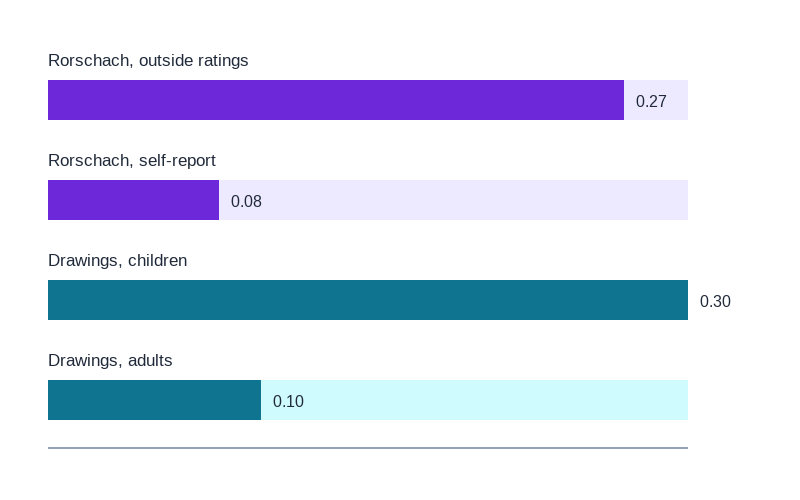
First, Rorschach scores differ in support. A systematic review of 65 Comprehensive System variables ran 53 meta-analyses against outside criteria such as observer ratings and diagnoses, and 42 against self-report. Against outside ratings the mean validity was 0.27. Against self-report it was 0.08. Thirteen variables had excellent support and seventeen good support, while ten had modest support, thirteen had little or none, and twelve had no relevant studies at all.
The strongest scores measured thinking and perception, for example the Perceptual-Thinking Index. Scores about rare signs or newer scales fared worst. The authors concluded that the instrument is neither uniformly valid nor worthless: a subset of scores earns real support (Mihura and colleagues, 2013).
Second, figure drawings screen intelligence poorly. In one study, 100 young children took the Draw-A-Person IQ test alongside a Wechsler scale, and 100 adults took it alongside a brief Wechsler measure. In children the correlation was about 0.30, weak to modest. In adults it was 0.10 and not significant. More telling than correlations, the drawing test misclassified individuals: it placed only 36 of 100 children and 51 of 100 adults in the correct ability band.
For borderline functioning it missed every true case and flagged only wrong ones. For superior functioning it missed half the gifted children and all gifted adults, while most of its gifted labels were wrong. The authors concluded that practitioners should not rely on human figure drawings as intelligence screens (Imuta and colleagues, 2013).
Third, construction methods work best as supplements. A 2025 systematic review screened 641 papers and kept 25 studies with 3,854 children and adolescents. Average study quality was 4.4 out of 9, and 13 of the 25 reported no psychometric data at all. The review found these techniques valuable for opening up children's inner worlds in diagnosis and therapy, but not definitive on their own. Its verdict matches the older literature: useful inside a broader assessment, with clear awareness of limits (Santillo and colleagues, 2025).
A related terminology point helps reading. In 2006, Meyer and Kurtz proposed retiring the words objective and projective as test labels, because both families mix objective data with subjective judgment. They suggested rating-scale or self-report measures for fixed-choice tests and free-response measures for projective ones. The new words never fully caught on, but the warning behind them stands: no test is purely objective, and no projective result interprets itself.
How to keep the terms apart when you study
Students meet these terms together, so confusion is normal. Five hooks keep them sorted.
- Sort by response format first. If the person picks from options, the test is objective. If the person produces stories, drawings or completions, it is projective.
- Link each method to one verb. Rorschach means see inkblots. TAT means tell stories. Draw-A-Person means draw figures. Sentence completion means finish stems. Word association means answer with the first word.
- Attach one validity line to each. Rorschach thinking scores hold up best. TAT motive scores work in large research samples. Drawings do not screen intelligence. Sentence stems invite editing. Associations reflect habit as well as complexes.
- Remember the two numbers that summarize the debate. Against outside ratings the Rorschach mean was 0.27, while against self-report it was 0.08. In children drawings correlated about 0.30 with IQ tests, while in adults the value was 0.10 and missed significance.
- Treat every projective result as a hypothesis, not a verdict. Expect it to be checked against interviews, records and objective scores before anyone draws conclusions.
If you are learning these terms for a course, save projective test, Rorschach test, thematic apperception test, draw-a-person test, sentence completion and word association to one list in Psychology World. Drill the list with Flashcard, Question and Typing. The word of the day brings one term back each day at a time you choose. Related methods that guard study quality, such as who stays blinded in a study and objective trait inventories, sit in the same methods cluster.
Keep the terms from this post
Look them up in Psychology World, save them to a list and study them.
Frequently asked questions
What is a projective test in psychology?
A projective test presents ambiguous stimuli with no correct answer and interprets the person's free response as revealing motives or conflicts. Common examples are inkblots, vague pictures, unfinished sentences and first-word associations.
What is the most famous projective test?
The Rorschach inkblot test is the best known. The person describes ten symmetrical inkblots, and trained examiners score what was seen, where on the blot, and how answers compare across cards.
What is an example of a projective test besides the Rorschach?
The Thematic Apperception Test is a leading example. The person invents stories about ambiguous scenes, covering what led up to each scene, what the characters feel, and how it ends.
Are projective tests reliable and valid?
Some scores are, most are not. Rorschach scores about thinking and perception show the best support, with a mean validity of 0.27 against outside ratings. Figure drawings show weak validity as intelligence screens and misclassify many individuals.
What is the difference between projective and objective tests?
Projective tests use ambiguous stimuli with free responses interpreted by an examiner, while objective tests use clear questions with fixed choices scored by a standard key. Projective formats resist faking but score less consistently.
How is the TAT administered?
The examiner shows ambiguous pictures one by one and asks for a story per picture. The person covers the lead-up, the present action, the characters' thoughts and the outcome, and the examiner analyzes themes across stories with other data.
Is the MMPI a projective test?
No. The MMPI gives first-person statements that the person marks as true or false, so it is a fixed-choice self-report inventory scored by a standard key. That format is the opposite of a projective test (Minnesota Multiphasic Personality Inventory).
Sources
- Mihura, Meyer, Dumitrascu and Bombel (2013). The validity of individual Rorschach variables.
- Imuta, Scarf, Pharo and Hayne (2013). Drawing a Close to the Use of Human Figure Drawings as a Projective Measure of Intelligence.
- Santillo and colleagues (2025). Projective in Time: A Systematic Review on the Use of Construction Projective Techniques.
- Wikipedia contributors (2026). Projective test.
- Wikipedia contributors (2026). Minnesota Multiphasic Personality Inventory.