Psychodynamics
Psychological projection: why you accuse others of what you feel yourself
 Yusuf DemirciContent Writer at Psychology World
Published 7 Nov 2026 · 8 min read
On this page
Please note
Psychology World is an educational reference, not diagnosis or treatment. If you need help, talk to a doctor or a qualified professional.
Psychological projection is an unconscious defence. You attribute your own unwanted feeling, impulse or trait to another person and fight it there, instead of seeing it in yourself.
It protects your self-image in the short term. It strains relationships, because the other person is blamed for your topic. This article defines it in plain words, shows three examples, and gives a test that sorts it from displacement.
- Projection is unconscious. If you decide to accuse, it is not projection.
- Three marks define it: unconscious, unwanted in yourself, fought in the other person.
- Typical examples are jealousy suspicion, claims that others lie, and anger read as hostility.
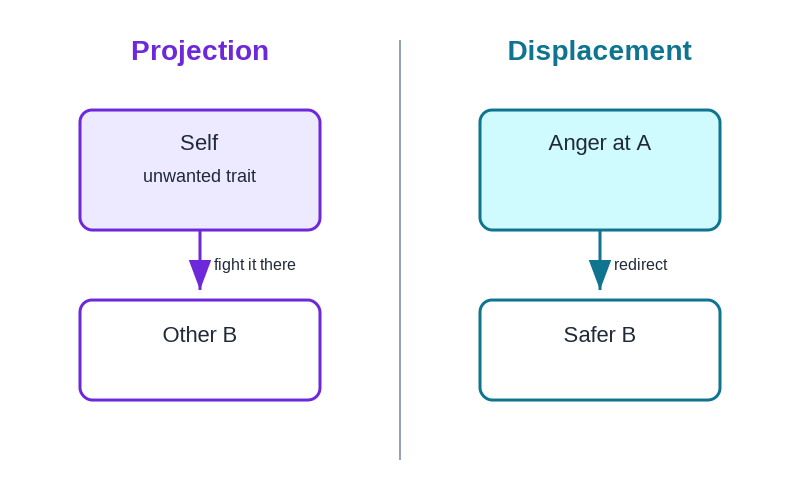
- Displacement redirects anger to a safer target. Projection attributes your trait to the target.
- Studies support the pattern but question the classic defence claim.
Keep the terms from this post
Look them up in Psychology World, save them to a list and study them.

What psychological projection is
Projection is a defence mechanism in which a person attributes inner traits to others. The traits are usually feelings, impulses or wishes that do not fit the self-image. The process runs without conscious decision.
Sigmund Freud introduced the concept. Anna Freud and others refined it later. The full list of defences is long. You can read the twelve defences in one sentence each for the whole family, and Freud's structural model for the id, ego and superego behind it.
Three marks must all apply. First, the process is unconscious. Second, the trait is unwanted in yourself. Third, you fight it in the other person. If one mark is missing, it is something else.
The mechanism also appears in tests. The Rorschach inkblot test uses ten standard inkblots. The Thematic Apperception Test uses twenty pictures with clear but open scenes. Both ask for stories about unclear material, and the answers can reveal needs and attitudes (EBSCO Research Starters (2013). Psychological projection.). The tests are controversial, but they show how the idea entered assessment.
Jung extended the idea. Freud stressed unwanted drives and affects. Jung added that people also attribute valued inner parts, such as ideals or the Shadow with denied parts, to others or to groups (Britannica (2026). Projection.). The extension is useful, but exams usually ask for the Freud form.
Three examples that show it
Each example follows the same pattern. The feeling starts in you. You do not accept it. You then see it in the other person and react to it there.
Jealousy suspicion in a relationship
A person feels impulses toward unfaithfulness but holds loyalty as part of the self-image. Instead of noting the impulse, the person suspects the partner. The partner is checked, messages are read, delays become proof.
Freud separated normal jealousy from projected jealousy and from delusional jealousy (EBSCO Research Starters (2013). Psychological projection.). The example above fits the middle form. It is an illustration, not a diagnosis of any real couple.
Claims that others lie or manipulate
A person wants control but sees control as bad. The person then says that others are manipulative. Every neutral request sounds like pressure. Every rule sounds like a trick.
The accusation fits the accuser better than the target. The feeling was present before the other person acted. Those two signs point to projection. They do not prove it in a single case, but they justify a second look.
Anger read as hostility at work
A person harbours anger but fears anger. A colleague gives neutral feedback. The person hears hostility and reacts as if attacked.
Therapy practice describes the same pattern: a strong reaction to a stranger, certainty about what the stranger thinks, and phrases such as no one ever listens (MindClear Psychotherapy (2024). Psychological Projection: What is it and What to do With it.). The reaction says more about the inner state than about the present meeting.
Keep the terms from this post
Look them up in Psychology World, save them to a list and study them.
Projection vs displacement: the test that sorts them
Students mix these two defences. The test below keeps them apart. Ask where the trait started and where it went.
| Question | Projection | Displacement |
|---|---|---|
| Where did it start | in you, as unwanted trait | in you, as anger at person A |
| Who receives it | person B, accused of your trait | person B, safer than A |
| What is fought | your trait, in the other | your anger, on the wrong target |
| One-line check | fits you better than them | anger belongs to A, lands on B |
Use these steps in order.
- Name the accusation in plain words.
- Ask if the trait also fits you now.
- Ask if you felt it before the other person acted.
- If both answers are yes, check projection and pause.
- If the anger belongs to A but lands on safer B, call it displacement.
Deliberate false accusation is neither. If a person knows the claim is false and uses it for gain, that is lying. Projection requires that the move stays unconscious.
Neighbours to keep apart
Four neighbours cause most errors. The table lists each with its mark.
| Term | What happens | How to tell it apart |
|---|---|---|
| Denial | refuses an outer fact that is plain | no attribution to a person, only refusal |
| Projective identification | attributes and pressures, so the other starts to behave as expected | the other changes; a man in rage sees the wife as angry and she soon becomes angry (Britannica (2026). Projection.) |
| Prejudice | judges a group as bad | group target, not one relationship; seeing self in others is universal and does not prove defence in one case |
| Simple mapping | assumes others are like you | covers good and bad traits; it is a cognitive bias, not proof of defence |
Mature forms differ from primitive forms. In a mature form, the other keeps a separate inner life with motives that can differ from yours (Britannica (2026). Projection.). In a primitive form, self and other are not well kept apart.
What studies show, and where evidence is thin
Research supports the pattern but limits the classic claim. People do see their own traits in others. The false consensus effect, first described by Ross, Greene and House in 1977, shows a broad tendency to assume others are similar to the self.
A 1998 review reached a careful verdict. It found that the view that people defend by projecting specific bad traits to deny them in self is not well supported (Baumeister, Dale and Sommer (1998). Freudian Defense Mechanisms and Empirical Findings in Modern Social Psychology.). The same review found that projection is evident, but it may be a by-product of defence rather than the main defensive act (Baumeister, Dale and Sommer (1998). Freudian Defense Mechanisms and Empirical Findings in Modern Social Psychology.).
A newer model explains the by-product. People try to suppress thoughts about an unwanted trait. Suppression makes that trait highly accessible. The accessible trait then shapes how they read others (Baumeister, Dale and Sommer (1998). Freudian Defense Mechanisms and Empirical Findings in Modern Social Psychology.).
In this view, the defence is the suppression. The reading of others follows from it.
History matches this caution. Freud first described the concept in letters to Wilhelm Fliess. Karl Abraham and Anna Freud refined it later (Wikipedia (2026). Psychological projection.). The concept therefore has a clear origin, but its strength as a defence remains debated. Treat it as a useful map with thin spots, not as a proven law.
Projection and psychology terms
Projection belongs to a cluster of terms students must keep apart. Save it with displacement, denial and projective identification in one list. Drill the list with Flashcard, Question and Typing. Question needs four or more words in a list, so add a fourth term before you start the game.
Use the lookup-save-drill loop. Look up the term when you meet it. Save it to a list for defences. Drill the list until each term shows Known. A word a day keeps the cluster active.
Keep the terms from this post
Look them up in Psychology World, save them to a list and study them.
Frequently asked questions
How do you know if someone is projecting onto you
Look for an accusation that fits the accuser better than you, and that started before you acted. Ask what evidence supports the claim. If the pattern repeats across people, consider projection as one option, not as proof.
What is an example of projection in psychology
A person with unacknowledged jealousy accuses the partner of jealousy. A person who fears anger hears hostility in neutral feedback. Both follow the three marks: unconscious, unwanted in self, fought in the other.
How to deal with someone with psychological projection
Pause and name your own feeling first. Ask if the other reading could be possible. Discuss the present event without labels from the past. If talks repeat and distress lasts, talk to a doctor or a qualified professional about next steps.
Why do people project their insecurities
Attribution can protect self-image and lower guilt, anxiety or shame in the short term. Suppression can also make the trait highly accessible, so it shapes how others are read. Neither reason proves projection in one single case.
Is psychological projection real
The pattern is real: people attribute inner states to others. The classic claim that this move hides the trait from self is not well supported as a defence (Baumeister, Dale and Sommer (1998). Freudian Defense Mechanisms and Empirical Findings in Modern Social Psychology.). Treat it as a bias with defensive uses, not as a proven shield.
Sources
- Britannica (2026). Projection.
- EBSCO Research Starters (2013). Psychological projection.
- Wikipedia (2026). Psychological projection.
- MindClear Psychotherapy (2024). Psychological Projection: What is it and What to do With it.
- Baumeister, Dale and Sommer (1998). Freudian Defense Mechanisms and Empirical Findings in Modern Social Psychology.