Conditioning
Skinner box: the chamber that made reinforcement visible
 Yusuf DemirciContent Writer at Psychology World
Published 23 Nov 2026 · 11 min read
On this page
Please note
Psychology World is an educational reference, not diagnosis or treatment. If you need help, talk to a doctor or a qualified professional.
A Skinner box is a small test chamber that made learning visible as a rate. An animal presses a lever or pecks a key inside the box. Food drops as the result. A recorder plots each response, so the slope of the line shows how fast the animal responds. Burrhus Frederic Skinner built it as a Harvard graduate student to study how results change behavior.
This article explains what the chamber is, how a trial works, what it proved about reinforcement, and where its limits lie. You will also find the two corrections most summaries bury: a 2020 retest of the famous pigeons, and the truth about the air crib.
- A Skinner box is an operant conditioning chamber: an enclosed box with a lever or key, a feeder, signals, and a recorder.
- It grew from Edward Thorndike puzzle box work, and Skinner used it first with rats, then with pigeons.
- The chamber showed how reinforcement and punishment change response rate, plus shaping, stimulus control, and schedules.
- Pigeons fed on a fixed clock developed rituals in 1948, but a 2020 retest points to species-typical food behavior instead.
- The box is not a puzzle box and not an air crib, and it cannot prove that any species can learn anything.
Keep the terms from this post
Look them up in Psychology World, save them to a list and study them.

What the Skinner box is
An operant conditioning chamber, known as a Skinner box, is a laboratory apparatus used to study animal behavior. The chamber was created by Burrhus Frederic Skinner while he was a graduate student at Harvard University. Skinner created it as a variation of the puzzle box first built by Edward Thorndike. His early studies used rats, and he later moved to pigeons.
Thorndike had proposed the law of effect in 1898, and it formed the basis of operant conditioning. Skinner built on that work and added reinforcement to it. The box gave him a controlled place to test single ideas about behavior and to record each response as it happened.
One naming note helps. Skinner did not use the term himself, and he once asked Howard Hunt to use lever box in a published document. The name Skinner box is believed to come from Clark Hull and his Yale students. Because the source states it as a belief, treat it as attribution rather than settled fact.
The parts, and what each one does
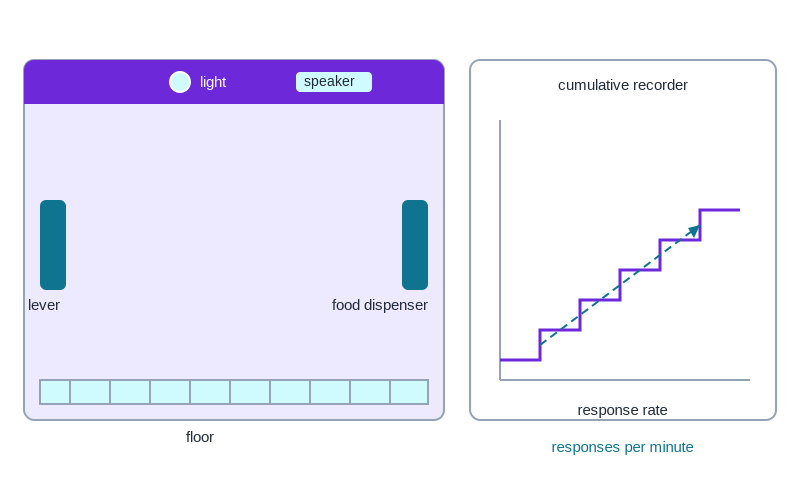
The box is sound-proof and light-proof, so outside events do not disturb the animal. Each part has one job, and together they turn behavior into a number: responses per minute.
- A lever for rats, or a lit disk for pigeons, that the animal can move on its own.
- A food dispenser that drops a pellet when the target act occurs.
- A light or speaker that signals when a response will pay off.
- A floor that can deliver a mild shock in some setups, used to study punishment or release from shock.
- A cumulative recorder that draws each response as a step on a moving paper roll, so the slope of the line shows response rate.
The recorder is the point of the whole device. Before it, observers wrote notes about what animals did. With it, they read a slope: steep means fast responding, flat means slow or stopped.
A run-through: the hungry rat
A standard textbook trial runs in six steps. Real labs vary hunger levels and timing, so read this as the shape of the method, not as one fixed protocol.
- Place a hungry rat in the chamber and let it explore the empty space.
- Wait while the rat sniffs, rears, and touches the walls and the lever.
- Let the accidental press happen: the rat leans on the lever and a food pellet drops.
- Repeat the pairing a few more times until the rat links press with food.
- Watch deliberate pressing start: the rat returns to the lever and presses on purpose.
- Stop the food and watch extinction: pressing slows and then stops because it no longer pays off.
Because the animal must act on its setting to gain the reward, the process is known as operant or instrumental conditioning. The word operant marks the core idea: the animal operates on its world, and the result changes what it does next.
What the chamber proved
The box isolated single variables: one signal, one act, one result. That control let Skinner and others test each principle below on its own. Each term gets one sentence in plain words.
| Idea | What it means in one sentence |
|---|---|
| Positive reinforcement | The act grows because something wanted follows it, such as food after a press. |
| Negative reinforcement | The act grows because something unwanted stops when it occurs, such as a shock that ends at a press. |
| Positive punishment | The act shrinks because something unwanted follows it, such as a mild shock after a press. |
| Negative punishment | The act shrinks because something wanted goes away after it, such as food stopped after a press. |
| Extinction | The act fades because it no longer pays off at all. |
| Stimulus control | The act tracks a signal, so pressing pays off only while a light is on. |
| Shaping | A rare act is built by rewarding closer and closer tries toward it. |
Two schedule findings matter most for study. Continuous reinforcement, where each press pays, teaches a new act fastest. Partial reinforcement, where only some presses pay, builds a habit that resists extinction far longer. Ferster and Skinner set out the schedules in their 1957 book, and later work on learning still starts from that map. For the four schedules in detail, read the four schedules of reinforcement in detail.
The four consequence terms confuse students most. Keep them apart with one anchor. Reinforcement always grows the act, and punishment always shrinks it. Positive always adds something, while negative always takes something away. A longer comparison sits in positive vs negative reinforcement, told apart.
Keep the terms from this post
Look them up in Psychology World, save them to a list and study them.
The superstitious pigeons, and the 2020 correction
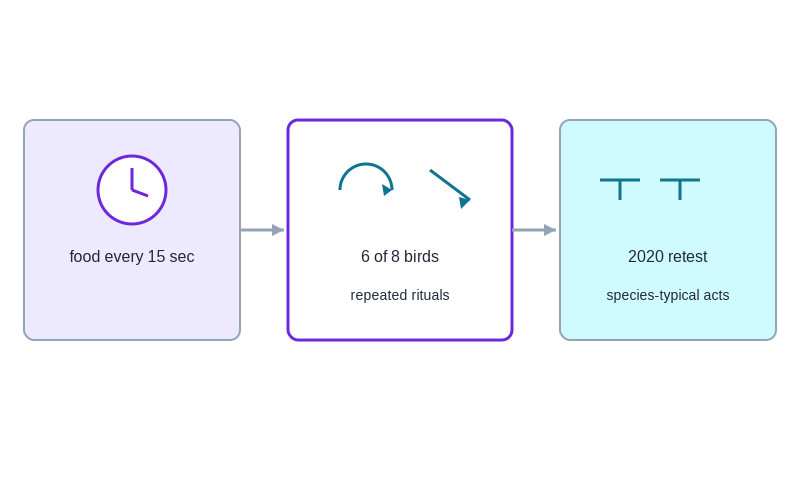
In 1948 Skinner ran a striking test. He fed hungry pigeons on a fixed clock, about every 15 seconds, with no link at all to what each bird did. In 6 of 8 cases the birds still developed clear repeated acts.
One turned counter-clockwise two or three times between feeds. One thrust its head into a corner. One tossed its head as if lifting an unseen bar. Two swung head and body side to side. One made brushing moves toward the floor.
Skinner called the result a kind of superstition. The bird acted as if its moves caused food that would arrive in any case.
The claim needs its context. The birds sat at about 75 percent of free-fed weight, and the 15-second gap suited that hunger level. Longer gaps let extinction cancel the effect, and Skinner said so in the paper itself. The finding was about timing and coincidence, not about pigeons holding beliefs.
In 2020 Fernandez and Timberlake repeated the fixed-time feeding across pigeons, doves, and chickens with modern methods. No species developed the one-bird-one-ritual pattern Skinner had reported. Each species fell back on its own food-getting acts instead, such as scratching and pecking the floor in chickens. That result revises the mechanism behind the 1948 show: species-typical food behavior explains the acts better than a kept-by-chance ritual. It does not overturn reinforcement itself, and the field treats it as a correction to one display, not as a rejection of the chamber.
Three things it is not
Students mix the chamber with two older devices and one later idea. The table below keeps them apart.
| Device | What the animal does | What the setup measures |
|---|---|---|
| Skinner box | Presses a lever or pecks a key freely, many times in a row | Rate of a repeated act under controlled results |
| Thorndike puzzle box | Escapes a latched box by a single act, such as pulling a loop | Time to escape across separate trials |
| Air crib | Nothing: it is a bassinet, and no conditioning happens in it | Infant comfort and care, not learning |
| Classical setup | Shows a reflex to a paired signal | Size of a reflex response |
The puzzle box came first and gave Skinner his start, but the methods differ. Thorndike cats worked to get out, trial by trial. Skinner rats and pigeons worked to get food, act by act, while the recorder drew the rate. How operant conditioning differs from classical conditioning covers the wider split between the two learning types.
The air crib causes the most confusion. In 1945 Skinner built a metal crib with a safety-glass front and walls, raised on legs, to give infants a warm and clean place to sleep. It was a bassinet with easier care, not a conditioner, and no child was trained inside it. A lasting rumor claimed his daughter Deborah grew up in a Skinner box, fell ill, sued him, and died by suicide. She denied each part of that story herself in 2004.
What the box cannot show
A controlled box proves control, not the whole of learning. Four limits belong in any fair account.
First, evolution sets bounds. Keller and Marian Breland trained animals with standard methods. Both had studied under Skinner. They watched the animals drift back to inborn acts even at the cost of reward. A raccoon trained to drop a coin instead rubbed it between its paws, as if washing food. Training could not hold against instinct where the two clashed.
Second, animals map their world. Edward Tolman argued that maze rats build inner maps rather than piling up single strengthened habits. A rising press rate fits a rat that learned that pressing leads to food just as well as one shaped by results alone.
Third, much learning needs no direct reward at all. Albert Bandura showed that children copy new acts after watching a model, without being reinforced themselves. Read the mechanism in learning by watching without direct reinforcement.
Fourth, reflexes leak into the box. Pigeons will peck a key that merely predicts free food, a classically conditioned response called autoshaping that Brown and Jenkins described in 1968. It intrudes on any claim that the chamber measures purely operant acts.
None of these limits break the device. Each marks an edge: cognition, history, and social models shape what any schedule can do. Shaping itself, the rewarding of closer tries, has its own full treatment in shaping by successive approximations.
How to keep the terms apart when you study
Six terms carry most exam marks here: positive reinforcement, negative reinforcement, positive punishment, negative punishment, extinction, and shaping. Learn them as pairs with one test each.
- Ask first whether the act grows or shrinks: growth means reinforcement, shrinkage means punishment or extinction.
- Ask next what changed: added means positive, removed means negative.
- Ask last whether the result still pays: if nothing follows any more, expect extinction.
- Build shaping last: it is the only one of the six that constructs a new act from tries, not a single result.
Save the six terms to one named list. Drill that list until each answer comes without thought. Psychology World is a psychology and psychotherapy dictionary for iPhone and iPad with 23,944 terms in English and German. Save terms to your own lists and drill them with Flashcard, Question and Typing games. You get one word of the day at a time you choose. Search inside definitions and track study progress with Pro.
Keep the terms from this post
Look them up in Psychology World, save them to a list and study them.
Frequently asked questions
What is a Skinner box in simple words?
A Skinner box is a small controlled chamber. An animal presses a lever or pecks a key and a result follows. A recorder plots each response, so learning shows as a rate.
What did the Skinner box prove?
Results change the rate of an act. Added or removed rewards grow it. Added or removed unpleasant events shrink it. Partial schedules hold behavior longer than continuous ones.
Were rats or pigeons used in the Skinner box?
Both were used: early work ran with rats pressing levers, and later work ran with pigeons pecking lit keys.
Is the Skinner box cruel?
Critics raise animal welfare concerns about food restriction, small chambers, and shocks. Supporters point to strict lab rules today. This article states the concern without giving any protocol to copy.
Was Skinner's daughter raised in a Skinner box?
No credible evidence supports that story: the air crib was a climate-controlled bassinet for infant care, not a conditioner, and Deborah Skinner denied the rumors herself in 2004.
How is a Skinner box different from a puzzle box?
A puzzle box tests escape across separate trials and measures time out, while a Skinner box tests a repeated free act and measures its rate under controlled results.