Cognition
Conscious vs subconscious: what each word means, and which one psychologists use
 Yusuf DemirciContent Writer at Psychology World
Published 23 Nov 2026 · 8 min read
On this page
Please note
Psychology World is an educational reference, not diagnosis or treatment. If you need help, talk to a doctor or a qualified professional.
Conscious describes what you are aware of right now. Subconscious is the everyday word for mental activity outside your immediate awareness, while psychologists use unconscious as the technical term for that same territory. None of the three names a place in the brain.
This article defines all four terms, including preconscious. It explains why the textbooks say unconscious where everyday speech says subconscious. It also shows one experiment that measured automatic processing, and two questions that replace the which-mind-was-it contest.
- Conscious: what you notice, decide and report at this moment.
- Subconscious: the everyday word for what runs outside awareness.
- Unconscious: the technical term the professional literature uses.
- Preconscious: material outside awareness that you can recall with ease.
- No layer diagram shows a brain fact; name the process instead.
Keep the terms from this post
Look them up in Psychology World, save them to a list and study them.

What does conscious mean?
Conscious describes the thoughts, feelings and decisions you are aware of at this moment. You read this sentence, you weigh its claim, you choose to keep reading. That is conscious processing.
Conscious processing handles will, attention and report. You direct your focus, you consider options, you state the result. The words deciding to exercise belong here: a person notices the need, chooses the run, and guides each step.
One more sense of the word needs a fence around it. "Knocked unconscious" after a fall describes a medical state, not a mental process. It means the person does not respond. If someone does not respond after a head injury, seek emergency help.
What does subconscious mean?
The dictionary defines subconscious as existing in the mind but not immediately available to consciousness, in the words of Merriam-Webster's entry for the word. A motive you cannot inspect, a habit you run without steering, a memory that surfaces on its own: everyday speech calls all of these subconscious.
That makes subconscious a broad everyday word, not a precise mechanism. It covers a recalled address, a practiced skill and a first impression with the same label. The breadth explains its popularity and its weakness.
Self-help books often draw it as a layer under the conscious mind, like an iceberg under water. The picture feels clear. It is still an analogy, not an image of the brain.
Why do psychologists write unconscious instead?
The short history is simple. Sigmund Freud used subconscious and unconscious interchangeably at first, then kept unconscious to avoid confusion, as Harvard Health describes the debate. The German word for the later term was already in his theory, and the other word added nothing.
Professional writing followed him. Across psychoanalysis, psychiatry, psychology and neuroscience, writers use unconscious rather than subconscious, in the words of the same Harvard Health overview. Subconscious stayed in everyday use, where it is rarely defined with care.
The deeper history supports the same point. The German term Unterbewusstsein arrived through later writers, while Freud's own term was das Unbewusste, according to a peer-reviewed history of consciousness research. So when a textbook writes unconscious, it follows the technical vocabulary, not a fashion.
Freud's levels of awareness differ from his structural model of the mind. If you want that second model, read Freud's model of id, ego and superego. Keep the two models apart and each stays clear.
What does preconscious mean?
Preconscious names the narrow middle case. It means material that is not in consciousness now but can return without inner resistance or repression, in the words of Merriam-Webster's entry for the word. A phone number you recall when asked is the classic test.
That test separates it from its neighbours. A recalled address fits the preconscious definition: present, retrievable, no struggle. A repressed memory does not fit, because recall meets resistance. For repressed material and its terminology, see repression and other defence mechanisms.
Use the word only for this case. When the material is a habit or an association rather than a recallable fact, preconscious is the wrong label.
Keep the terms from this post
Look them up in Psychology World, save them to a list and study them.
Is the subconscious a place in the brain?
No. Some writers in brain science object to the word unconscious. It sounds like a location, a true anatomical location as it were, in the words of the Harvard Health overview. No scan shows a subconscious compartment.
Modern accounts describe cooperation, not floors. Conscious processing selects, checks and leads, while fast routines handle the practiced parts. One history of the field states plainly that conscious and unconscious agendas in the brain always work together, in the words of Deecke's review.
Brain talk still has limits. A writer can say that attention selects and memory stores. A writer cannot point at a region and call it the subconscious. Keep the words for processes and states, and the confusion shrinks.
Conscious vs subconscious vs unconscious vs preconscious
| Term | What it means | Example | Who uses it |
|---|---|---|---|
| Conscious | What you are aware of right now | Deciding to exercise | Everyone |
| Subconscious | The everyday word for activity outside awareness | Typing without watching your fingers | Everyday speech, self-help books |
| Unconscious | The technical term for activity outside awareness | A motive you cannot inspect | Psychology, psychiatry, neuroscience |
| Preconscious | Outside awareness now, recallable with ease | A phone number, when asked | Psychoanalysis, textbooks |
Read the table down the last column first. The last column tells you which word your reader expects. A psychology exam expects unconscious; a conversation accepts subconscious.
Why do explanations of these words disagree?
Three registers share the same words. Everyday speech uses subconscious as a broad shorthand for anything unnoticed. Freud's theory uses conscious, preconscious and unconscious as defined parts of one model. Modern research uses implicit and automatic for measured processes.
Trouble starts when a claim from one register borrows authority from another. A speech error may feel meaningful, yet it does not reveal a hidden wish on its own. For that classic case, see Freudian slips. A recalled address may feel retrieved from a vault, yet it shows only that the fact was available.
Keep each observation with its own register. Describe the experience first, then ask which process the evidence supports. The next section shows what measured evidence looks like.
What does the research actually show?
In 1935, John Ridley Stroop printed colour words in mismatched inks and asked people to name the ink colours. Reading is fast and practiced, so the visible words pulled against the naming task. Naming 100 ink colours took 63.3 seconds plain and 110.3 seconds with conflicting words, a rise of 74 percent, in the words of the original paper.
Those words were visible the whole time. The finding is interference between two responses, not proof of a hidden personality. People saw the words and still struggled to suppress the reading habit.
Practice changed the picture. Eight days of naming mismatched colours cut the interference time by 16.8 seconds, about 34 percent, along a typical learning curve, in the words of the same paper. Repetition moves a deliberate task toward automaticity. That is the measured claim behind every honest version of "train your autopilot."
The two questions that replace which-mind-was-it
Stop asking which mind acted. Ask two smaller questions instead. First, write down what you observed, before you explain it. Second, name the process that best fits: a recalled fact, a practiced skill, or an automatic association.
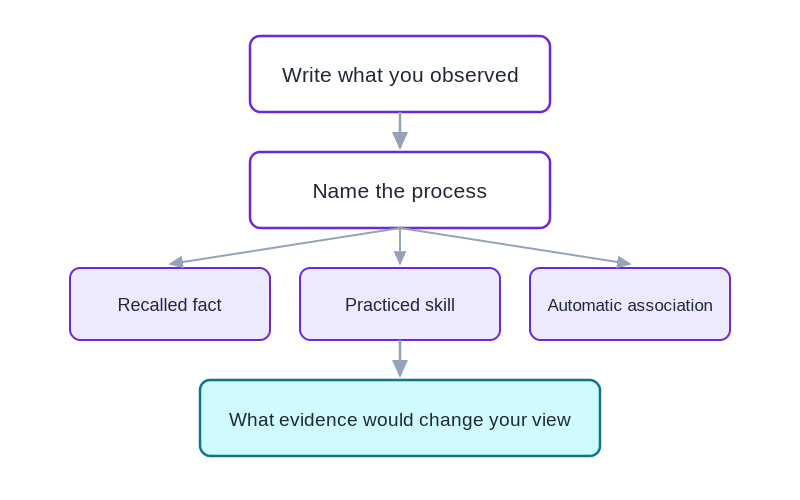
A recalled fact points to the preconscious vocabulary, and to explicit and implicit memory for the full distinction. A practiced skill points to automaticity of the Stroop kind. A first impression points to relevance checks: what did you notice, what else could explain it, what evidence would change your view.
Treat fixed percentages with the same care. You will meet claims that one mind decides a fixed share of your choices. Ask for the study, the definition and the measure behind the number. Without those three, the figure is a slogan, not a finding.
How this helps you study
Save the four terms as one list and learn the differences cold. Psychology World lists 23,944 terms for iPhone and iPad. Save conscious, subconscious, unconscious and preconscious to a list, then drill the list with Flashcard, Question and Typing.
If low mood or worry persists and disturbs daily life, talk to a doctor or a qualified professional. Terminology articles cannot replace that conversation.
Keep the terms from this post
Look them up in Psychology World, save them to a list and study them.
Frequently asked questions
Is the subconscious stronger than the conscious?
That question has no winner, because strength depends on the task. A practiced skill runs faster than deliberate control, while a new decision needs conscious attention. Define the task first, then compare.
Did Jung use unconscious or subconscious?
Use unconscious for the technical term. For the Jungian idea itself, read the collective unconscious, which explains that concept in full.
Can I change automatic habits?
Practice shifts interference, as Stroop's eight-day result shows. Expect gradual change with repetition, not a switch. No method in this article promises more than that.
Should I write subconsciously or unconsciously?
For an unnoticed everyday action, readers accept either word. Plainer words work better: write "without noticing" or "automatically." Never use either for medical loss of consciousness.
What about superconscious?
You will meet superconscious in spiritual writing about higher awareness. It is not one of psychology's four terms above, so this article leaves it out.