Cognition
Selective attention: how the mind picks one voice out of noise
 Yusuf DemirciContent Writer at Psychology World
Published 25 Nov 2026 · 13 min read
On this page
Please note
Psychology World is an educational reference, not diagnosis or treatment. If you need help, talk to a doctor or a qualified professional.
Selective attention picks one stream of sights, sounds, or thoughts for full processing and reduces the rest. The mind has a limited capacity, so it cannot process every sound, sight, and thought at once. This article defines the term, shows how researchers test it, compares the main models, and shows how to use it for psychology terms.
- Selective attention selects one stream and reduces the rest because capacity is limited.
- Dichotic listening with shadowing shows the ignored ear keeps physical traits but loses most meaning.
- A familiar name in the ignored ear still breaks through in about one trial in three.
- Broadbent proposed an early block, Treisman a weakened signal, Deutsch and Deutsch a late choice, and Lavie a load-dependent shift.
- For study, give one list full capacity in a low-distraction block and test by recall.
Keep the terms from this post
Look them up in Psychology World, save them to a list and study them.

What is selective attention?
Selective attention picks one stream of sights, sounds, or thoughts for full processing and reduces the rest. You follow one conversation in a noisy room, read while traffic hums outside, or track one task while other demands wait. The rest receives less processing. The reason is capacity: the mind can fully process only a small part of the input at one time.
This limit shapes behavior. When you attend to one message, you extract its meaning. When you ignore another, you often keep only basic traits such as pitch or location. Researchers study this trade-off with controlled listening tasks, described in the next section.
Selective attention differs from its neighbours. Divided attention splits resources between two tasks at once. Sustained attention holds focus over time during watch for rare events. Selective attention picks one source now and reduces the rest. The neighbours table below returns to this difference.
How do researchers test selective attention?
Researchers test it with listening tasks that built the field, visual tasks that show the cost, and conflict tasks that measure control.
- Set up dichotic listening. Play one message to the left ear and a different message to the right ear at the same time. Ask the listener to shadow one ear, which means to repeat its message aloud as it arrives. Treat the other ear as the ignored channel.
- Check what the listener keeps from the attended ear. Listeners report its content with ease. They follow the story, recall details, and stay with the ear they shadow.
- Check what the listener keeps from the ignored ear. In the early work by Colin Cherry in 1953, listeners missed the meaning of the ignored message. They did not notice a switch from English to German, and they missed a repeated word even after many repeats. They still noticed physical changes, such as a switch from a male to a female voice. Cherry's dichotic listening experiments describe the shadowing setup. Our explainer on the cocktail party effect covers the party version of this setup and the numbers behind it.
- Test a meaningful cue. In 1959 Neville Moray placed instructions in the ignored ear, some starting with the listener's own name. Listeners without warning followed the instruction in 4 of 12 cases, about one in three. Two later replications found 34.6% and 29%, as detailed in our explainer on the cocktail party effect. The result matters because a strict early block cannot explain it.
- Test meaning across ears. In 1960 Anne Treisman moved a coherent story from the attended ear to the ignored ear mid-sentence. Listeners often spoke the next words from the ignored ear to keep the sentence logical, then switched back when they noticed. The meaning pulled attention across physical channels. This finding supports a weaker filter rather than a full block.
- Measure detection with a second task. In 1967 Treisman and Geffen asked listeners to shadow one ear and tap when they heard a target word in either ear. Detection reached 87% in the shadowed ear and 8% in the ignored ear. The gap shows strong selection with some residual signal, not zero processing.
- Check the visual cost. When attention stays on one task, fully visible items can go unnoticed. The basketball-pass video with a person in a gorilla suit is the classic case. Miss rates vary widely by task and condition, from about 17% to about 92% across gorilla conditions. Read the numbers and the sorting question in inattentional blindness and change blindness compared.
These steps give a test that sorts any example. Ask what the listener would need to notice the item. If only a physical change suffices, such as a new voice or a tone, early selection explains it. If meaning is needed, such as a name or a sentence continuation, the signal survived to a later stage. If task load is high, fewer distractors survive at all.
Which model explains selective attention?
Four models agree on limited capacity and differ on the fate of ignored information.
| Model | Filter location | Ignored information | Selection basis |
|---|---|---|---|
| Broadbent early filter (1958) | Before meaning | Blocked fully, then lost | Physical traits only: ear, pitch, location |
| Treisman attenuation (1960, 1964) | Before meaning, but leaky | Weakened, not blocked; low thresholds let names through | Physical traits plus meaning for pertinent items |
| Deutsch and Deutsch late selection (1963) | After meaning | Fully processed for meaning; only pertinent items reach awareness | Momentary importance, called pertinence |
| Lavie perceptual load (1995) | Moves with load | Under low load, distractors get processed; under high load, they do not | Available capacity: demanding tasks leave none for distractors |
Donald Broadbent proposed the early filter in 1958. Information enters a sensory store, a filter picks one physical channel, and only that channel reaches the limited-capacity stage where meaning is assigned. The split-span digit task supported it: listeners recalled digits ear by ear, not pair by pair, as if the filter stayed on one channel for efficiency. The model explains Cherry's result, but it cannot explain Moray's name breakthrough or Treisman's ear-switch without extra rules.
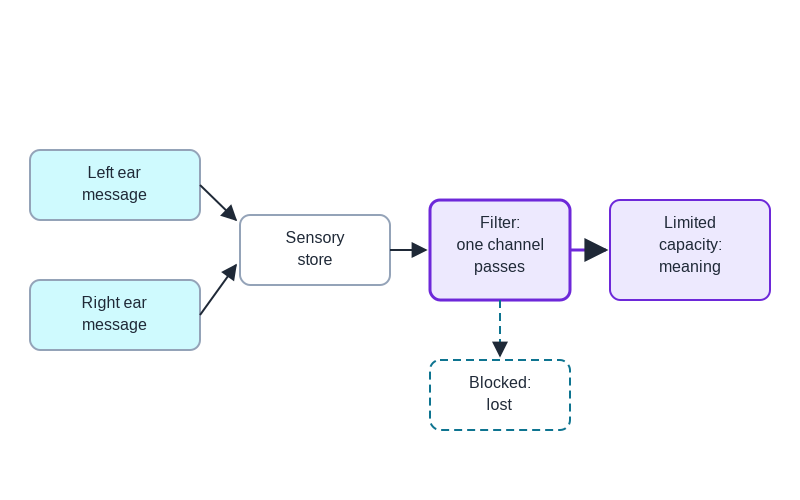
Anne Treisman kept an early bottleneck but replaced the block with attenuation. The ignored signal turns down, like reduced volume, and travels on with the attended signal to a store of known words. Each word has a threshold for recognition. Common or important words, such as a name or fire, have low thresholds and need little signal. Current context can lower a threshold for a short time, which is called priming. The model explains the 33% name rate and the ear-switch, and it predicts the 87% versus 8% gap when a second task needs a motor response.
Deutsch and Deutsch moved selection late in 1963. Every input receives full semantic analysis, and only the most pertinent reaches awareness. Pertinence means momentary importance for current goals or state. The model explains meaning-based breakthroughs, but it struggles with the sharp 87% versus 8% gap and with load effects unless extra limits are added.
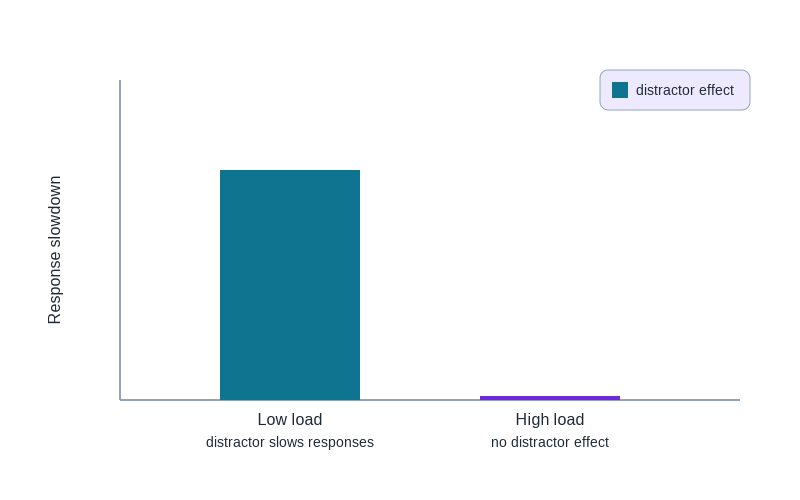
Nilli Lavie shifted the question in 1995 from place to load. With low perceptual load, spare capacity spills to distractors and selection looks late. With high perceptual load, the main task absorbs capacity and selection looks early.
In her visual search task, a peripheral distractor slowed responses under low load and had no effect under high load. Later work found the same pattern with engaging images and with brain measures of early visual response. The load account does not replace the other models. It states when each pattern appears.
For study, the practical point is stable across models: reduce competing streams and test the target from memory. The next section applies this point.
Control of attention also matters. Goals guide selection from above and salient events pull it from below. Read top-down and bottom-up control of attention for how these two directions interact. The brain work behind selection starts early. In hearing, attended and ignored tones differ in brain response within about 100 milliseconds. This modulation supports language, literacy, and math in development, as reviewed in 2012 by Stevens and Bavelier.
Keep the terms from this post
Look them up in Psychology World, save them to a list and study them.
Selective attention vs divided attention vs sustained attention
The table separates the three types by question, task, and limit.
| Type | Question it answers | Task example | Limit |
|---|---|---|---|
| Selective attention | Which stream do you process now? | Shadow left ear, ignore right ear | Ignored stream loses meaning |
| Divided attention | Can you do two tasks at once? | Take dictation while reading for meaning | At least one task suffers unless highly practiced |
| Sustained attention | Can you stay ready over time? | Watch a radar screen for rare signals | Readiness drops as time passes |
Use one question to sort any case. Ask how many tasks need full processing at the same moment. If the answer is one stream now, the case is selective. If the answer is two demanding tasks at once, the case is divided. If the answer is readiness over a long watch, the case is sustained.
Divided attention deserves a warning. With long practice on a fixed pair, some people learn to combine two complex tasks, as in a 17-week dictation-plus-reading study. Change the tasks slightly and the cost returns. Driving work shows the same point: a phone conversation impairs hazard response even hands-free, and drivers often fail to recognize objects they looked at. For study, treat multitasking as switching: give one list full capacity, then switch, then test.
How to use selective attention for psychology terms
Selective attention is not only an exam term. It is the skill you use when you encode terms. Each drill session is a selection task: one list in focus, the rest reduced. The routine below applies the models without jargon.
- Build one small list. Look up selective attention and its neighbours and save them into one named list, such as Attention 1. Add divided attention, sustained attention, dichotic listening, shadowing, Broadbent filter, Treisman attenuation, and cocktail party effect. Keep the list short enough to finish in one block.
- Remove competing streams. Silence notifications, close other tabs, and study one list at a time. High load on the target leaves less capacity for distractors, which is the practical side of load theory.
- Drill the list three ways. Use Flashcard for recognition, then Question for choice among options, then Typing for recall by writing. Question mode needs at least 4 words in the list. Prefer elaborative rehearsal beats maintenance rehearsal: explain each term in your own words instead of repeating it.
- Test from memory. Use the active recall routine: close the list, write each definition, then check. Recall strengthens the path more than rereading.
- Return to the same list in short blocks across days. Track progress with study progress, which is a Pro feature, and use search inside definitions, also Pro, to check wording fast. A word of the day habit helps: one term each day at a time you choose, off until you turn it on.
Psychology World supports this loop on iPhone and iPad. Look up a term, save it into a named list, and drill the same list with Flashcard, Question, and Typing. Search inside definitions and study progress are Pro features that speed review. The word of the day shows one term each day at a time you choose, and stays off until you turn it on.
As of 2026, the evidence for training is promising but specific. Practice improves the trained task and near variants. Broad transfer to all school subjects needs more work. Treat the routine above as skill practice for terms, not as a general capacity upgrade. The 2012 review by Stevens and Bavelier reaches the same caution. Selective attention relates to language, literacy, and math through specific mechanisms, and training studies show task-linked gains, as summarized in the EBSCO research starter.
Mistakes people make about selective attention
Three common errors, each with a correction.
First, the name myth: you always hear your name across a noisy room. The data say sometimes, not always. Moray found about one in three without warning, with replications near 30 to 35%. Expect breakthrough for highly pertinent cues, not constant monitoring. For exam answers, state the rate and the small sample: 4 of 12 in the original, plus two replications.
Second, the multitasking myth: you can give two demanding tasks full attention at once. Divided-attention work shows a cost in at least one task for most people and most pairs. Long practice can reduce the cost for a fixed pair, but a small change restores it. When the stakes are high, do one demanding task at a time.
Third, the perfect-filter myth: the filter blocks everything early and meaning never leaks. Treisman's ear-switch, the name breakthrough, and the 8% detection in the ignored ear with a tap task all show leakage. Use attenuation or load language: reduced, not zero. For the sorting test, ask whether meaning was needed. If yes, the signal reached a later stage.
A final note on development and differences. Card-sort studies show selection improves with age during childhood. Researchers also study differences in conditions that affect attention. This article does not diagnose or assess anyone. If attention problems impair daily life, talk to a qualified professional.
Keep the terms from this post
Look them up in Psychology World, save them to a list and study them.
Frequently asked questions
What is an example of selective attention in psychology?
Following one conversation at a party while other voices become background noise is the standard example. In the lab, shadowing one ear in dichotic listening while missing the meaning in the other ear shows the same selection. Hearing your own name in the ignored stream is a second example, but it happens in a minority of trials, not every time.
What are the three types of attention in psychology?
Many courses group attention into selective, divided, and sustained. Selective picks one stream now. Divided shares resources between two tasks at once. Sustained holds readiness over time for rare events. Use the sorting question in the neighbours table: one stream, two tasks, or long watch.
What is Broadbent's theory of selective attention?
Broadbent proposed an early filter in 1958. The filter picks one physical channel, such as an ear, by pitch or location, and blocks the rest before meaning is assigned. Only the selected channel reaches the limited-capacity stage. Cherry's shadowing results fit it, but name breakthrough and meaning-based ear switches need Treisman's attenuation or a late stage.
What is the difference between selective and divided attention?
Selective attention processes one stream and reduces the rest. Divided attention attempts two tasks at once and pays a cost in speed or accuracy in at least one task for most pairs. Study with selective focus: one list, one block, then test. Do not read new terms while answering messages and count both as study.
Does selective attention improve with practice?
Selection improves during childhood, and practice improves the trained task. Adults show similar early brain modulation once cues guide them well, while control structures mature more slowly. For terms, practice the exact skill: select, encode in your own words, and recall. Expect gains on the practiced lists first.
Why do people miss obvious things when they focus hard?
Because focused selection reduces processing of the rest. Inattentional-blindness work shows fully visible items go unnoticed during a demanding count, with miss rates from about 17% to about 92% across conditions. The cost is not a flaw in vision. It is the price of giving limited capacity to the target.
Sources
- Friedrich, F. Attention. Noba textbook series: Psychology.
- McLeod, S. (2026). Theories of Selective Attention in Psychology. Simply Psychology.
- Stevens, C. and Bavelier, D. (2012). The role of selective attention on academic foundations. Developmental Cognitive Neuroscience.
- EBSCO (2024). Selective attention. Research Starters: Psychology.
- Simons, D. J. and Chabris, C. F. (1999). Gorillas in our midst. Perception.