Personality
Introvert vs extrovert: what the difference is, and how to tell which you lean toward
 Yusuf DemirciContent Writer at Psychology World
Published 26 Nov 2026 · 9 min read
On this page
Please note
Psychology World is an educational reference, not diagnosis or treatment. If you need help, talk to a doctor or a qualified professional.
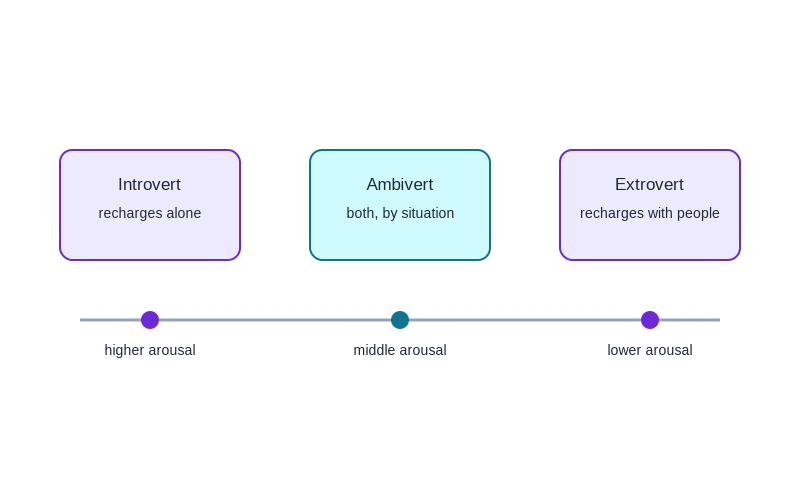
Introvert vs extrovert is about energy, not shyness. Introverts recharge alone and prefer lower stimulation. Extroverts recharge with people and seek stimulation. Most people sit somewhere between the two ends.
This article defines each side in plain words and shows the difference in one table. It traces where the terms came from, explains the ambivert middle, tests common myths, and gives a one-question test to sort any example. It uses extraversion as one Big Five factor as its parent idea and links onward instead of repeating it.
- Energy decides the difference: alone restores introverts, people restore extroverts.
- Shyness is fear of judgment; introversion is a need for less stimulation.
- Neither type is better; each fits some settings and strains in others.
- Most people sit in the middle, called ambivert.
- A 2013 sales study found middle scorers ahead, in one company only.
- Newer labels such as omnivert rest on little research.
Keep the terms from this post
Look them up in Psychology World, save them to a list and study them.

What is the difference between introverts and extroverts
The difference is what restores you and how much stimulation you prefer, the core pattern in Cleveland Clinic's guide to the two types. Introverts pay energy in social settings and recover it alone. Extroverts spend energy alone and recover it with people. It is not about confidence, skill, friendliness, or worth.
| Dimension | Introverts | Extroverts |
|---|---|---|
| Energy | Recharge alone; long social spells drain them | Recharge with people; long alone spells rest them |
| Social settings | Prefer one-to-one or small known groups | Prefer groups, new faces, and shared talk |
| Friendships | Few close bonds, built slowly | Many bonds, built fast, kept through contact |
| Communication | Think before speaking; prefer depth | Think out loud; prefer breadth |
| Work | Fit independent detail work | Fit interactive team work |
| Arousal | Higher resting arousal, so less input suits them | Lower resting arousal, so more input suits them |
The arousal row comes from Eysenck's cortical arousal account below. Treat it as a model with mixed support, not a brain fact. The rest of the table describes behavior you can watch.
What introversion is
Introversion is the low end of the extraversion scale. An introvert directs energy inward, toward reflection, ideas, and a small circle. Time alone restores focus. Small known groups feel workable. Large noisy groups tire fast.
Typical signs include a small close circle, care before speaking, comfort with routine, and a need to pause after social spells. Proposed kinds include social, thinking, anxious, and restrained introverts, as Positive Psychology's review describes them. Treat the four kinds as proposed labels, not settled facets. They help you notice variety among introverts. They do not diagnose anyone.
Introverts can lead, speak in public, and enjoy people. The preference is for less input at once, not for no input. Practice can build skills without moving the underlying trait.
What extraversion is
Extraversion is the high end of the same scale. An extrovert directs energy outward, toward people, action, and novelty. Contact restores drive. Groups feel workable. Long quiet spells feel flat.
Typical signs include ease with new faces, fast talk, quick decisions, and appetite for change. Facets discussed in research include sociability, assertiveness, activity level, and positive emotionality, as Simply Psychology's review of the trait summarizes. Facets can split in one person. Someone can be assertive yet not gregarious.
Extroverts can listen, reflect, and work alone. The preference is for more input at once, not for constant noise. Quiet practice can build focus without moving the underlying trait.
Where the terms came from
The terms date to the early 1900s. Swiss psychiatrist Carl Jung set out attitude types in Psychological Types, issued in 1921 with an English edition in 1923. He framed introversion as an inward turn toward subjective content and extraversion as an outward turn toward objects. Later use shifted toward observable sociability. Sources differ on the first year, so read 1921/1923 as the book anchor, not as a single first-mention fact.
Hans Eysenck gave a biological account. He proposed that introverts carry higher resting cortical arousal and extroverts lower arousal, so extroverts seek stimulation to lift arousal and introverts avoid it to keep arousal down. Course texts still teach this loop of reticular arousal and cortex. Later work offers a rival: reward sensitivity drives approach more than sociability itself. Imaging results are mixed and samples are small, so treat arousal as a useful model, not a settled cause.
The Big Five treats extraversion as one broad factor among five: openness, conscientiousness, extraversion, agreeableness, and neuroticism, as Positive Psychology's Big Five summary lists them. It is descriptive. It places everyone on a scale instead of sorting people into types. Scores cluster near the center. That is why the middle has a name.
Keep the terms from this post
Look them up in Psychology World, save them to a list and study them.
What the ambivert middle is
Most people sit between the ends. The middle name is ambivert. An ambivert shifts with the setting: reserved with strangers, lively with close friends, talkative to start a task, quiet to finish it. The term dates to the 1920s, though sources differ on whether Conklin in 1923 or Young in 1927 coined it.
A 2013 study tested the middle at work. Adam Grant measured extraversion in 340 outbound call-center staff at one software company and tracked revenue for three months, in the sales study Simply Psychology summarizes. Revenue rose with extraversion to a point, then fell, so middle scorers led. The middle band outsold the low end by around a quarter and the high end by around a third in that sample.
Read the limits with the result. It is one job type at one company, and the design is correlational. Later work is mixed and does not repeat the same test. Hiring guides that screen for ambiverts overstate the finding. The safe lesson is narrower: balance of talking and listening helps in persuasion, and extremes can cost.
A newer label, omnivert, describes swings from fully introverted to fully extroverted across settings rather than a stable middle. It has very little published research. Treat it as pop language, not a measured type.
Which myths fail the evidence
Myth: introverts are shy. Verdict: false as a rule. Shyness is fear of judgment. Introversion is a stimulation preference, a distinction Simply Psychology draws the same way. Unsociability is low drive without fear, while anxious withdrawal is avoidance with fear despite a wish to connect. Only the second tracks social anxiety.
Myth: one type is better. Verdict: false. Research and clinics find strengths on both sides. Extroverts often build rapport fast and take visible roles. Introverts often hold focus, check detail, and listen. Fit depends on the task.
Myth: introversion is the same as autism. Verdict: false. Both can favor alone time, for different reasons. Introverts recover from ordinary social load. Autistic withdrawal often reflects sensory load or masking effort. Autistic people span the extraversion range.
Myth: extroverts are happier, so introverts should change. Verdict: overstated. Studies link extraversion to positive affect, but the link is correlational and depends on context, health, and relationships. Do not rank lives by a trait score. If low mood persists, talk to a professional.
Myth: introverts are better listeners and extroverts cannot focus. Verdict: unproven. Tests find listening tracks behavior such as interrupting less, not trait scores. Focus tracks habits and setting, such as noise, sleep, and task fit.
Myth: culture and music prove the biology. Verdict: partial. Western settings often reward outgoing behavior, while some Eastern settings prize restraint, and lab music effects fit arousal theory. Cross-cultural measures vary with schooling and format, and brain studies use small samples. Treat each as suggestive, not decisive.
How to tell where you lean
Ask one question: what restores you after strain. If quiet alone time restores you, you lean introvert. If lively contact restores you, you lean extrovert. If each restores you at different times, you sit near the middle.
Check the pattern across weeks, not one evening:
- Note your setting for two weeks: small or large groups, quiet or buzz.
- Rate energy after each block from 1 to 5.
- Mark who you sought: solitude, one close friend, or a group.
- Compare restore blocks, not fun blocks.
- Name the lean in pencil, not ink.
Use the label to plan, not to limit. If you lean introvert, book solo prep before meetings and cap back-to-back social blocks. If you lean extrovert, book talk-through time and group work, plus short quiet resets. Practice the other mode in small doses. Traits stay fairly stable, while skills grow.
Introvert vs extrovert for psychology terms
Psychology World fits this routine. Look up introvert, extrovert, and ambivert, save them to a list for the course, and drill the list with the Flashcard, Question and Typing games. Search inside definitions and study progress are Pro features that show which terms still need work. The word of the day brings one term each day at a time you choose, and it stays off until you turn it on. The app runs on iPhone and iPad. Question mode needs four or more words in a list, so short lists still work with Flashcard and Typing.
For method, follow memorise psychology terminology to build the list first, then test before flipping and space reviews over days. Link the trait to extraversion as one Big Five factor instead of relearning the five-factor model here.
Keep the terms from this post
Look them up in Psychology World, save them to a list and study them.
Frequently asked questions
Are introverts shy
No. Shyness is fear of negative judgment. Introversion is a preference for less stimulation and more inward processing. Many introverts speak well in small groups and lead teams. Many shy people are extroverts who fear evaluation.
Is it better to be an extrovert
No. Each end fits some tasks and strains in others. Groups and sales calls favor outgoing moves. Detail checks and deep study favor quiet moves. Plan around the task instead of ranking the traits.
What is an ambivert
An ambivert sits near the middle of the scale and shifts with the setting. They enjoy people at times and need alone time after. It is the common position, not a rare third type. One sales study found middle scorers ahead in one company, but the result has not been repeated as a general rule.
Can an introvert become an extrovert
Underlying position stays fairly stable, but behavior can stretch. You can practice public speaking, small talk, or quiet focus in small steps. Skills grow without changing the trait. Judge progress by what you can do, not by a new label.
Do introverts dislike people
No. Introverts often value deep bonds and long talk with a few close friends. They tire from breadth and noise, not from care. Shorter contact, smaller groups, and solo recovery keep social life workable.
Sources
- Cleveland Clinic (2026). Introvert vs. Extrovert: Understanding Personality Types.
- Simply Psychology (2026). Introvert vs. Extrovert Personality.
- Simply Psychology (2026). What Is an Ambivert Personality?
- Positive Psychology (2025). Introvert vs. Extrovert: Understanding the Spectrum.
- American Women's College Psychology Department. PSY321 Course Text: Theories of Personality.