Studying
How to use flashcards to remember psychology terms
 Yusuf DemirciContent Writer at Psychology World
Published 26 Nov 2026 · 9 min read
On this page
Please note
Psychology World is an educational reference, not diagnosis or treatment. If you need help, talk to a doctor or a qualified professional.
Use flashcards as self-tests, not as notes to reread. Write one question on each card and try to answer from memory before you turn it over. Send the cards you miss back for sooner review, and spread the reviews over days.
The method works because it combines the two strongest study habits found in a large review of learning research. Practice testing means pulling answers from memory, and distributed practice means spreading study over time. Both earned the highest utility rating across more than 700 studies. Tested word pairs were recalled at 35 percent after one week against 4 percent for untested pairs, and repeatedly tested translations at 80 percent against 36 percent for restudied ones. Spaced study beat massed study 47 percent to 37 percent across 254 studies with more than 14,000 learners.
This guide shows the full routine for psychology terms. It covers cards that force recall, reviews with Leitner boxes, and spacing over days. It also shows which mistakes waste the method and how paper and app cards compare.
- Test yourself from memory on every card before you flip it.
- Keep one idea on each card, written as a question in your own words.
- Sort misses back for sooner review and let correct cards wait longer.
- Space reviews over days and mix the order of the cards.
- Check the answer each time and never leave an error uncorrected.
Keep the terms from this post
Look them up in Psychology World, save them to a list and study them.

Why testing beats rereading
Reading a card and nodding along feels smooth, but it builds little lasting memory. Pulling the answer from memory does the work. Cognitive psychologists call this practice testing, and the delayed advantage of testing over restudy is often called the testing effect.
The clearest test used short science passages of about 250 words. One group read a passage four times, one group read it three times and took one recall test, and one group read it once and recalled it three times. On a test after five minutes the repeated readers won. After one week the order reversed: the three-recall group scored about 5 percent above the one-test group and about 21 percent above the repeated readers. More recall attempts during learning gave more durable memory, even with far less rereading.
The same pattern shows up in the large review. Self-testing helps learners from preschoolers to medical students, for foreign words, spelling lists and parts of flowers, and the benefit lasts months to years. Feedback makes it stronger: checking the correct answer after each attempt, including after failed attempts, improved later recall, and in one study delayed feedback beat immediate feedback. The lesson for cards is direct, and it matches what active recall describes: read the front, produce the answer, then verify.
Write cards that force recall
A good card asks one small question with a short checkable answer. A weak card holds a paragraph, a long list, or a bare term with no context. The first is quick to test and easy to grade. The second lets you feel right while missing the part the exam asks for.
Follow these rules when you write cards.
- Put one idea on each card. If the answer has four parts, make four cards. Each card should take seconds to answer.
- Ask a real question on the front. Replace a bare term such as mitosis with what happens to the chromosomes in prophase. Why and how questions force you to explain, not recite.
- Write the answer in your own words. Rephrasing takes longer than copying, but it forces you to process the idea. Keep it short enough to check in one glance.
- Add a hint, example or picture when it helps. A short example pins down an abstract term. A quick sketch holds a process or diagram part. A mnemonic carries a list you keep mixing up.
- Test both directions. Look at the term and recall the definition, then look at the definition and recall the term. Both-way testing builds links that one-way review misses.
Keep cards current. Fix or delete any card you keep missing after several honest attempts, and split any card that keeps grading as half right.
Keep the terms from this post
Look them up in Psychology World, save them to a list and study them.
The review routine that makes cards stick
Cards fail most often in review, not in writing. The routine below turns a stack of cards into practice testing plus spacing. Do it in this order.
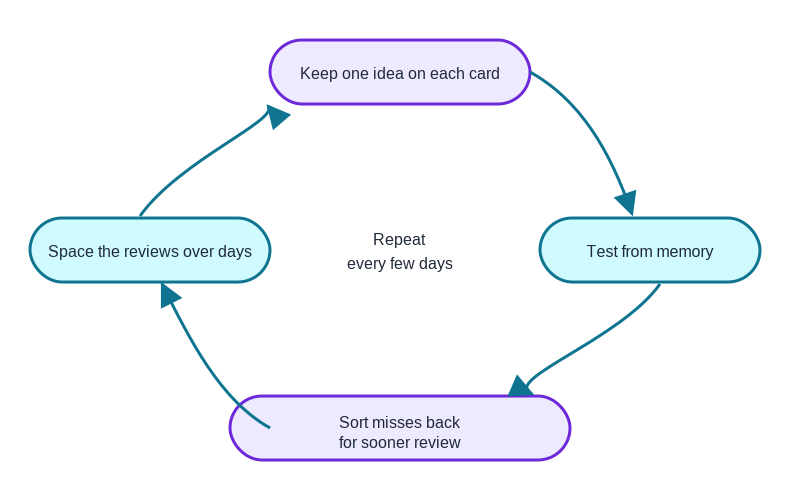
- Test, do not flip. Read the front, say or write the answer, and only then check the back. The effort of retrieval is the point.
- Sort by result. Cards you know move forward to less frequent review. Cards you miss go back to the first pile for sooner review. Spend more time on cards you do not know well.
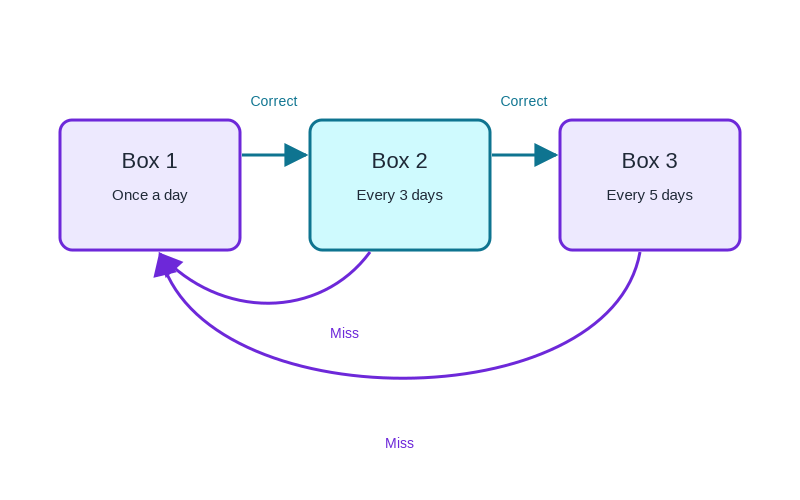
- Use Leitner boxes to run the sort. The Leitner system is a paper method from 1972 that schedules cards by result: correct cards advance to the next box with a longer wait, missed cards return to the first box. A simple setup uses three boxes. Review Box 1 cards once a day, Box 2 cards every 3 days, and Box 3 cards every 5 days. Hard cards stay in the early boxes, so study time goes where it is needed.
- Space the reviews over days. Longer gaps between sessions beat cramming for the same study time. As a rule, space sessions at about 10 to 20 percent of the time you want to remember: about 12 to 24 hours apart to hold material for one week. Start at least two weeks before the test and return to the full deck every few days.
- Mix the order. Shuffle the deck each round so you never learn the sequence instead of the answers. Mix topics within one course, which practices choosing the right idea, not just recalling one list. This matches what interleaving shows for similar problem types.
- Work in small batches. Take 5 to 10 cards at a time and review them until they feel comfortable, then add the next cards. Short sessions across days beat one long session, which is the idea behind spaced repetition.
Digital apps run the same schedule for you. They space known cards further out and pull missed cards back sooner, which is the Leitner idea in software.
Each round repeats the same loop: write, test, sort and space.
Paper cards or app cards
Both forms work when the routine above holds. Paper suits writers who remember through handwriting and want no screen. Apps suit large decks, automatic scheduling and study on the phone. Pick the form you will repeat daily, since consistency decides the result.
| Choice | Paper cards | App cards |
|---|---|---|
| Making cards | Slower by hand, spatial and focused | Faster, sometimes automatic from notes |
| Scheduling | Manual boxes and piles | Automatic spacing by algorithm |
| Carrying | Bulky for large decks | Thousands of cards on the phone |
| Media | Handwriting and sketches | Audio, images and video |
| Distractions | Almost none | Notifications can interrupt |
Mistakes that waste the method
Most failed decks share the same few errors. Each one has a direct fix from the studies above.
Copying the textbook word for word turns card making into typing practice. Rephrase each answer briefly instead. Flipping before answering turns testing into rereading, which wins at five minutes and loses at one week. Always produce the answer first. Packing a paragraph or a whole list on one card makes grading dishonest. Split it until each answer checks in seconds.
Reviewing every card evenly wastes the schedule. Send misses back and let known cards wait, as the boxes do. Cramming a huge deck the night before skips spacing entirely. Start early and return over days. Skipping feedback locks in errors. Guess first, then verify at once.
For lists of related terms, build the list first and then card each term. Our guide to memorise psychology terminology shows that list-building step. For ordered sequences where order matters, consider the method of loci as an alternative to plain cards.
Flashcards for psychology terms
Psychology World fits this routine. Look up each term, save it to a list for the course, and drill the list with the Flashcard, Question and Typing games. Search inside definitions and study progress are Pro features that show which terms still need work. The word of the day brings one term each day at a time you choose, and it stays off until you turn it on. The app runs on iPhone and iPad. Question mode needs four or more words in a list, so short lists still work with Flashcard and Typing.
Keep the terms from this post
Look them up in Psychology World, save them to a list and study them.
Frequently asked questions
How many flashcards should I review per day?
Review 5 to 10 cards at a time and repeat the round until the batch feels comfortable, then add more cards. Short sessions across days beat one long session. Start at least two weeks before the test and return to the full deck every few days.
Should I use paper flashcards or an app?
Use the form you will repeat daily. Paper helps writers who learn through handwriting and want no screen. Apps schedule reviews for you, carry large decks and add audio or images. Both work when you test before flipping and space the reviews.
How long until flashcards work?
Expect recall to feel harder than rereading from the first session, and expect the payoff on delayed tests after days and weeks of review. One review found benefits lasting months to years. Judge the method by delayed results, not by how smooth a session feels.
Do wrong answers hurt my memory?
No, as long as you check the correct answer right after each attempt. Failed attempts followed by feedback improved later learning compared with reading alone. Guess, then verify at once and never leave an error uncorrected.
Are flashcards enough for exams with problem solving?
Cards cover facts and basic concepts, which is what most psychology terms need. For application and problem solving, combine cards with practice questions and worked examples. Retrieval builds the facts, and transfer tasks build their use.
How often should I review flashcards?
Review missed cards daily and known cards every few days, then stretch the gaps as cards stay correct. A simple plan is Box 1 daily, Box 2 every 3 days and Box 3 every 5 days. For a test in one week, space learning episodes about 12 to 24 hours apart.