Development
Theory of mind: how children learn that other minds see the world differently
 Yusuf DemirciContent Writer at Psychology World
Published 23 Nov 2026 · 10 min read
On this page
Please note
Psychology World is an educational reference, not diagnosis or treatment. If you need help, talk to a doctor or a qualified professional.
Theory of mind is the ability to understand that other people hold beliefs, desires, intentions and knowledge that differ from your own and from reality. You use it whenever you predict what someone will do from what they think, rather than from what you know.
A child shows it when she says that Sally will look for a marble where Sally left it, even though the child herself saw it moved. Most children pass such verbal false-belief tasks around age 4. Reasoning about beliefs about beliefs, called second-order reasoning, follows around ages 6 to 7.
This article defines the term in plain words, separates first-order from second-order reasoning, and walks through the Sally-Anne and Smarties tasks step by step. It maps the developmental timeline and corrects two claims that summaries often overstate.
- Theory of mind means attributing mental states to people and predicting behavior from those states.
- False belief is the decisive test: someone acts on a belief that conflicts with reality.
- The Sally-Anne task tests belief about location; the Smarties task tests belief about appearance versus reality.
- Most children pass standard false-belief tasks around age 4; second-order reasoning arrives around ages 6 to 7.
- Theory of mind is cognitive perspective-taking, while empathy is emotional perspective-taking.
Keep the terms from this post
Look them up in Psychology World, save them to a list and study them.

What does the term mean?
Theory of mind is the capacity to ascribe mental states to yourself and to other people and to explain and predict behavior from them. Mental states include beliefs, desires, intentions, knowledge and emotions. Because no one can observe a mind directly, the states must be inferred from what people say, do and leave unsaid. The Stanford Social Learning Lab describes it as the ability to reason about what goes on inside other minds. That covers what they want, what they know and what they take to be true from past experience.
The word theory here does not mean a guess. It refers to the everyday explanatory framework that people carry around: minds hold representations of the world, and those representations guide action. Researchers debate how the framework works, with some proposing implicit rules and others proposing mental simulation, but the debate changes nothing about the definition above.
Theory of mind differs from empathy. Theory of mind is cognitive perspective-taking: working out what someone believes or knows. Empathy is emotional perspective-taking: recognizing and sharing what someone feels. Our article on empathy explained as emotional perspective-taking covers the emotional side in detail. The roots of the cognitive side reach back to early attribution research on explaining behavior, including Heider and Simmel's finding that people treat even moving shapes as agents with motives.
How can you tell that it is present?
Use one sorting question: does the person act on a belief that differs from reality? If yes, and the observer predicts that action, theory of mind is at work. Reporting reality alone proves nothing. Only a divergence between belief and reality shows that someone tracks a mind rather than the world.
That divergence comes in two levels. First-order reasoning tracks what someone believes about the world. Second-order reasoning tracks what one person believes about another person's belief. The table compares them.
| First-order | Second-order | |
|---|---|---|
| What it tracks | A belief about the world | A belief about a belief |
| Question asked | Where will Sally look for her marble? | What does Anne think that Sally thinks? |
| Typical age | Around 4 years | Around ages 6 to 7 |
| Example | Sally believes the marble is in the basket | Anne believes that Sally believes the marble is in the basket |
Which tasks reveal it?
Two classic tasks dominate teaching and research. They test different beliefs, so learn them as a pair rather than as two names for one test.
The Sally-Anne task
Baron-Cohen, Leslie and Frith adapted this location task in 1985 out of Wimmer and Perner's 1983 Maxi task. Maxi hides chocolate and leaves; his mother moves it; the child says where Maxi will look. The Sally-Anne version uses dolls and a marble.
- Show Sally placing a marble in her basket while Anne watches.
- Let Sally leave the scene so she sees nothing further.
- Move the marble to Anne's box in full view of the child.
- Bring Sally back and ask the child where Sally will look.
A child who answers the basket passes: she separates what she knows from what Sally believes. A child who answers the box fails: she reports reality, or her own knowledge, instead of Sally's belief. In the 1985 study, 85% of typically developing children and 86% of children with Down syndrome answered correctly, while 80% of autistic children failed. Later studies did not replicate that group pattern cleanly, as discussed below, so treat those numbers as one study's result rather than a fixed rule.
The Smarties task
The deceptive-container task, often called the Smarties or crayon-box task, tests appearance-versus-reality belief instead of location. It also probes memory of one's own past belief.
- Show the child a familiar tube that looks as if it holds sweets.
- Ask what is inside and let the child answer sweets.
- Open the tube to reveal pencils and close it again.
- Ask what another person, who has not looked inside, will think is in the tube.
A child who answers sweets passes: she steps into the other person's perspective. A child who answers pencils fails: she assumes everyone shares her new knowledge. Researchers also ask what the child herself first thought was inside. Younger children often deny ever having thought sweets. That denial shows how hard it is to treat a belief as a state that can be wrong and then updated.
Keep the terms from this post
Look them up in Psychology World, save them to a list and study them.
When does it develop?
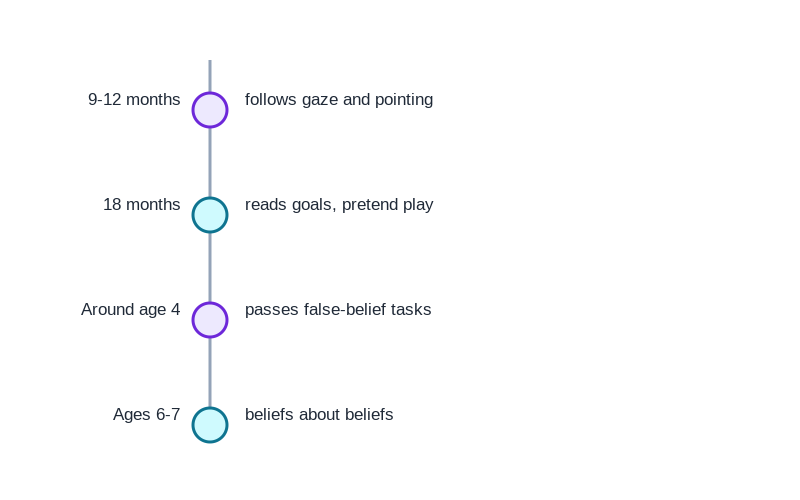
The roots appear in infancy. From about 9 to 12 months, infants follow gaze and pointing, which links attention to mental states. By about 18 months, toddlers in Meltzoff's 1995 re-enactment study performed the intended act an adult had tried and failed to complete. That result suggests they read goals rather than copying movements. Pretend play, such as treating a banana as a telephone, exercises the same skill of holding a scenario apart from reality.
The well-known shift comes between ages 3 and 5. Younger children answer with reality; older preschoolers answer with the character's belief. A meta-analysis by Wellman, Cross and Watson from 2001 pooled 178 studies with 591 false-belief conditions and confirmed the shift from below chance to reliably above chance around age 4. The exact timing moves with task wording, language demands, working memory and inhibitory control, so read age 4 as an average rather than a fixed birthday.
Second-order reasoning arrives later. A review of task studies reports that children develop some competence with second-order false-belief tasks between the ages of 6 and 7. By middle childhood, children coordinate multiple perspectives, follow stories with nested beliefs and grasp humor, teasing and sarcasm. Adults use these skills constantly, from negotiating to judging intent, yet they often fail to apply them. A sizable share of adults in communication-game studies still move objects a partner cannot see. Our article on why adults still show egocentric biases describes that side of the story.
Culture shapes the order of steps. In Western samples, children typically grasp diverse beliefs before they grasp knowledge access. Shahaeian and colleagues found in 2011 that Iranian and Chinese preschoolers show the reverse order: they grasp that seeing leads to knowing before they grasp that people hold different beliefs. The set of insights looks universal, while socialization changes their sequence. For the broader backdrop of egocentrism giving way to perspective-taking, see Piaget's preoperational egocentrism.
What happens in the brain?
No single mind-reading area exists. Instead, a set of regions sometimes called the mentalizing network becomes active when people reason about beliefs, desires and feelings. It includes the medial prefrontal cortex, the temporoparietal junction, the superior temporal sulcus, the precuneus and the amygdala. The medial prefrontal cortex helps separate your perspective from someone else's. The superior temporal sulcus reads social signals such as gaze and tone. The amygdala attaches emotional meaning to faces.
One finding ties a region specifically to belief reasoning. Saxe and Kanwisher compared false-belief stories with matched false-photograph stories, such as a photo of an apple that falls while the film develops. A region in the right temporoparietal junction responded selectively to the mental-state stories and not to the equally complex physical stories. The matched control is what makes the result persuasive: it rules out a generic response to outdated representations.
What do summaries overstate?
Two claims need more care than most summaries give them. The first concerns the 1985 Sally-Anne group result. The 80% failure figure for autistic children comes from one small early study, and later studies could not replicate the assertion in that form. Some autistic children pass false-belief tasks in the lab yet still find everyday social inference difficult, while executive demands explain part of the failures. Report the 1985 numbers as history, note the failed replications, and never use a task score to label any person or group. If you have questions about a child's development, talk to a pediatrician or another qualified professional.
The second concerns babies. Onishi and Baillargeon reported in 2005 that 15-month-olds looked longer when an actor reached in a way that contradicted her belief, as if surprised. Follow-up work extended the claim, but large replication attempts have since questioned how reliably this early sensitivity holds up, and a 2019 meta-analysis found weak and inconsistent effects. Looking-time sensitivity is not the same as explicit false-belief understanding, and verbal tasks remain the standard evidence for the preschool shift.
How can you remember these terms?
The cluster in this article rewards grouped study: theory of mind, false belief, Sally-Anne task, Smarties task, second-order false belief and mentalizing. Save them to a named list for developmental psychology in Psychology World on iPhone and iPad, where browsing and bookmarking stay free. Drill the list with the Flashcard, Question and Typing games, which the subscription unlocks as the full study toolkit, and note that search inside definitions and study progress stay Pro. The word of the day sends one term each day at a time you choose and stays off until you turn it on. Learning the two tasks as a pair, location versus appearance, keeps their names from blurring.
Keep the terms from this post
Look them up in Psychology World, save them to a list and study them.
Frequently asked questions
What is theory of mind in simple terms?
It is the understanding that people act on their own beliefs, which can differ from yours and can be wrong. You show it when you predict that Sally will look where she left the marble, even though you know it moved.
At what age do children develop theory of mind?
Most children pass standard verbal false-belief tasks around age 4, according to a meta-analysis of 178 studies. The roots appear in infancy, and second-order reasoning about beliefs about beliefs follows around ages 6 to 7.
What is an example of theory of mind in everyday life?
A teacher who explains a topic from what a student does not yet know is using it. So is a reader who recognizes sarcasm, or a negotiator who anticipates how an offer will look from the other side.
What is the difference between the Sally-Anne and Smarties tasks?
Sally-Anne tests belief about location: where Sally thinks her marble is after it moved. Smarties tests belief about appearance versus reality: what someone thinks is in a misleading container. Both test false belief from different angles.
What is second-order false belief?
It is understanding what one person thinks about another person's belief, as in what Anne thinks that Sally thinks. Children develop some competence with it between the ages of 6 and 7, later than first-order false belief.
How is theory of mind different from empathy?
Theory of mind is cognitive perspective-taking: working out what someone believes or knows. Empathy is emotional perspective-taking: recognizing and sharing what someone feels. The two draw on overlapping brain systems but answer different questions.