Memory
Working memory: what it is and how to study with it
 Yusuf DemirciContent Writer at Psychology World
Published 27 Nov 2026 · 10 min read
On this page
Please note
Psychology World is an educational reference, not diagnosis or treatment. If you need help, talk to a doctor or a qualified professional.
Working memory is the mind's temporary workspace. It holds a small amount of information in an accessible state while you use it to think, follow instructions, or learn.
It holds about four chunks at once, keeps them for seconds unless you refresh them, and works by using information, not by storing it. This article explains the four parts, the limits, and a study routine that respects them.
- Working memory holds plus manipulates; short-term memory only holds.
- The Baddeley and Hitch model has four parts: central executive, phonological loop, visuospatial sketchpad, and episodic buffer.
- Capacity is about four chunks; the older seven plus or minus two counts chunks, not items.
- Duration is seconds unless you rehearse or refresh the material.
- Training drills raise drill scores; they rarely transfer to schoolwork.
Keep the terms from this post
Look them up in Psychology World, save them to a list and study them.

What is working memory
Working memory is a system that keeps a small amount of information ready while you work with it. You use it when you follow spoken instructions, do mental arithmetic, or link the start of a sentence to its end. A review by Cowan describes it as the retention of a small amount of information in a readily accessible form, used for planning, comprehension, reasoning, and problem solving (Cowan (2014). Working memory underpins cognitive development, learning, and education.).
It differs from short-term memory in one clear way. Short-term memory keeps information briefly. Working memory keeps it and does something with it. A guide to the model puts it plainly: short-term memory temporarily holds information, while working memory actively uses, manipulates, and processes it (McLeod. Working memory model.).
| Short-term memory | Working memory | |
|---|---|---|
| What it does | Holds information briefly | Holds plus manipulates information |
| Typical task | Repeat a number back | Follow instructions that use the number |
| Model home | One store in the earlier three-store account | Four-part system in the Baddeley account |
| How it fails | Fades in seconds | Fades and overloads under competing demands |
The term working memory came from Miller and colleagues in 1960 for the plans we keep in mind while we act. Atkinson and Shiffrin used it in 1968 for their short-term store. Baddeley and Hitch showed in 1974 that one passive store could not explain the results, and proposed separate parts instead. For the earlier three-store background, see the earlier three-store account.
Test yourself with one case. You hear a new term, its definition, and an example, then you must use all three in a sentence. Holding the three pieces is storage. Combining them into a correct sentence is working memory at work.
What are the four parts of working memory
The Baddeley and Hitch model describes three parts, with a fourth added by Baddeley in 2000. Each part handles a different kind of material. They work together under central control (McLeod. Working memory model.).
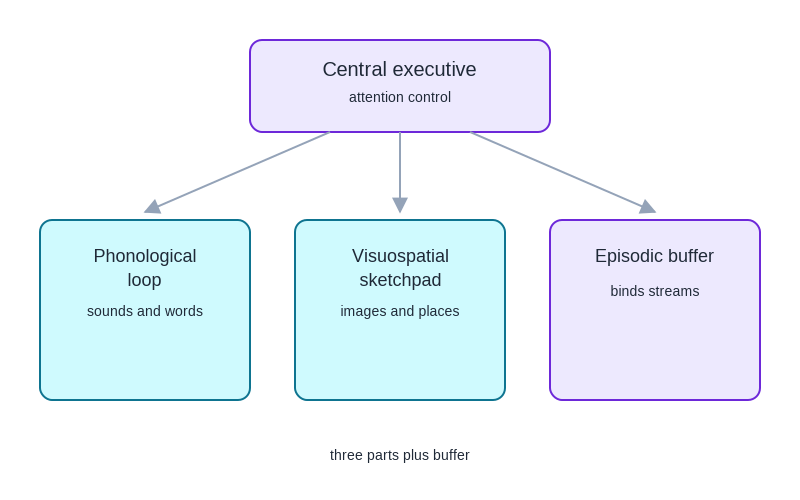
The central executive directs attention. It decides what to focus on, what to ignore, and which part should handle each piece. It also coordinates when two tasks run at once, such as listening while taking notes. It is the most important part and the least understood, because studies test one helper part at a time.
The phonological loop handles sounds and words. It has two sides. The inner ear holds speech-based traces for about one to two seconds. The inner voice repeats them silently to refresh them, and turns written words into a spoken code first. Three classic results support it: similar-sounding letters confuse recall, long words recall worse than short words, and repeating an irrelevant sound removes those effects for written lists.
The visuospatial sketchpad handles images and places. It keeps visual detail such as shape and colour, and spatial detail such as position and movement. You use it to picture a route, judge a parking space, or retrace your steps for lost keys. Later work splits it into a visual cache for form and colour and an inner scribe for space and movement.
The episodic buffer binds streams together. It combines verbal, visual, and spatial material into one episode, and links that episode to long-term memory. Recalling a birthday party uses it: faces, words, and feelings arrive as one meaningful event. It holds about four chunks or episodes in a shared code.
Sort any example with one question. Ask which material the task uses. Words and numbers point to the loop. Images and routes point to the sketchpad. Combining both into one memory points to the buffer. Choosing what to attend to points to the executive.
How much does working memory hold, and for how long
Capacity depends on chunks, not items. A chunk is a meaningful unit: one digit, one word, or one familiar triplet counts as one chunk each, depending on what you already know.
Miller proposed seven plus or minus two in 1956. That number counts chunks under good conditions with familiar material and free rehearsal. Cowan proposed about four chunks in young adults when chunking and rehearsal are limited. Both numbers describe the same system under different conditions. For study, plan for four.
Duration is short. Unrefreshed traces last seconds. Rehearsal extends verbal traces. Attention-based refreshing extends other traces. What matters most is cognitive load: the share of time taken by competing demands.
When load is high, recall drops even over short intervals. For the signs of overload and how to shrink the task, see why working memory gives up under load.
Three points keep the numbers honest. First, span varies with material: digits, letters, and words give different spans. Second, knowledge changes span: chess masters remember boards, not random pieces, because each board forms fewer chunks. Third, similarity hurts: similar sounds or similar places interfere more than mixed material. For the main trick that beats the limit, read about grouping terms into chunks.
Keep the terms from this post
Look them up in Psychology World, save them to a list and study them.
What are everyday examples of working memory
Everyday tasks show the workspace in action. Each one holds a little while doing a little.
- Do mental math. To add 24 and 18, you hold 4 plus 8 is 12, keep the 2, carry the 1, then finish the tens column. The middle results must stay ready while you use them.
- Follow directions. You hear three steps for a party setup, but the shoes end up in the closet and the table stays bare. The steps faded before you used them. A guide for families describes exactly this pattern with multi-step instructions (Rosen (2019). What is working memory.).
- Follow a recipe while cooking. You hold the next ingredient and the current heat level while you stir.
- Take notes in class. You hold the last sentence while you write it, and listen to the next one at the same time.
- Find your car. You hold the searched rows in mind so you do not search them again.
Children with learning disorders or attention difficulties carry extra load. Adjusting for a decoding or listening difficulty uses part of the workspace, leaving less room for new material. A clinical guide notes that this extra work means things get lost along the way, and lapses can look like disobedience when they are really overload (Jacobson (2026). What is working memory.). If a child often loses instructions or only finishes part of a task, an evaluation by a teacher or clinician can show where the load sits.
Stress also shrinks the workspace. Worrying thoughts compete for the same attention that refreshing needs. For one applied case where worry hurts scores, see how worry can drain working memory.
How do you study within the limits of working memory
Study with the limits, not against them. The routine below turns each limit into one move. Do it in order for one course list.
- Collect three or four related terms. Keep the set small so it fits in four chunks.
- Say each term and definition aloud once. This feeds the phonological loop through both entry and rehearsal.
- Draw one quick sketch for each term. A simple arrow diagram or place map feeds the sketchpad without splitting attention.
- Link the terms into one episode. Write one sentence that uses all three with their meanings. This gives the buffer one bound unit instead of three loose pieces.
- Test from memory, then check. Close the notes, recall each definition, and correct errors at once. For spacing those tests over days, use spacing reviews over days.
- Remove one competing demand. Silence notifications, keep one page open, and finish one step before the next starts.
What about brain training games that promise a larger workspace. Training reliably raises scores on the trained tasks. It shows no convincing transfer to reasoning, reading, or arithmetic when compared with a treated control group.
A summary of 87 studies with 145 comparisons reports exactly this pattern: near transfer yes, far transfer no (McLeod. Working memory model.). So train the material, not the muscle. Practice recalling the terms themselves.
Psychology World fits this routine without extra setup. Look a term up with search inside definitions, which is a Pro feature, and save it to a list for the course. Drill the list with Flashcard, then with Question once the list has four or more words, and track study progress per term, which is also Pro. The app holds 23,944 terms for iPhone and iPad, with Flashcard, Question and Typing as the three games. The word of the day brings one term each day at a time you choose, and it stays off until you turn it on.
What do people get wrong about working memory
Is working memory the same as short-term memory. No. Short-term memory names brief storage. Working memory names storage plus the work done on it. The full comparison with a table and exam wording sits in how short-term memory differs from working memory.
Does seven contradict four. No. Seven plus or minus two counts well-chunked familiar items with rehearsal. About four counts chunks when chunking and rehearsal are held back. Both describe capacity in chunks. For exams, write about four chunks and name the condition.
Does training expand the workspace. Current evidence says no for school skills. Scores on practiced tasks rise. Grades, reading, and reasoning do not reliably follow. Say what the meta-analyses say, and keep the claim narrow: practice improves recall of practiced material.
Is poor working memory a diagnosis. No. It is a description of performance under load, not a label for a child. Many factors raise load, including unclear instructions, noise, stress, and lack of sleep. If difficulty lasts across subjects and months despite clear steps, talk to a teacher, doctor, or qualified professional about an evaluation.
Is attention the same thing. No. Attention selects what enters. Working memory holds and uses what entered. The two fail together often, because unselected material never reaches the workspace, but they are separate steps.
Keep the terms from this post
Look them up in Psychology World, save them to a list and study them.
Frequently asked questions
What are the three main types of working memory
There are no agreed three types. The standard model has four parts: central executive, phonological loop, visuospatial sketchpad, and episodic buffer. Some summaries group them into three by leaving the buffer out, but the four-part version is current.
What is the Baddeley and Hitch working memory model
It is the account from 1974 that replaced one passive short-term store with an active system. A central executive directs attention, while a phonological loop handles speech and a visuospatial sketchpad handles images and places. Baddeley added the episodic buffer in 2000 to bind streams and link them to long-term memory.
What is the rule of 7 in working memory
It is Miller's 1956 finding that adults repeat back about seven chunks. Chunks are meaningful units, not single items. With unfamiliar material and limited rehearsal, the practical limit is closer to four chunks.
Can poor working memory be a symptom of something
Low scores often reflect high load, unclear instructions, stress, or lack of sleep rather than one cause. Children with learning or attention difficulties show higher load on the same tasks. Only a qualified professional can judge a cause, so seek an evaluation when difficulty lasts.
What is the difference between working memory and short-term memory
Short-term memory holds information briefly. Working memory holds it and manipulates it for a task. Repeating a number uses storage. Using that number in a calculation while remembering the next step uses working memory.
Can you improve working memory for studying
You can reduce load and strengthen recall of the material itself. Chunk terms, say them aloud, sketch them, link them into one episode, test from memory, and single-task. Drill scores rise with practice, but broad training rarely transfers to new subjects, so practice the terms you must know.