Social psychology
Stereotype threat: why fear of confirming a stereotype lowers test scores
 Yusuf DemirciContent Writer at Psychology World
Published 26 Nov 2026 · 10 min read
On this page
Please note
Psychology World is an educational reference, not diagnosis or treatment. If you need help, talk to a doctor or a qualified professional.
Stereotype threat is the worry that your score will confirm a negative stereotype about your group. That worry splits attention between the task and the fear, and hard tests suffer most. It needs no belief in the stereotype, and it hits hardest when the test feels diagnostic and the domain matters to you.
This article explains the two classic studies behind the term and the working-memory mechanism. It also covers threat versus lift and boost, five classroom practices, and what the largest replications found.
- Threat is situational: the same student feels it in one framing and not in another.
- Hard, diagnostic tests suffer; easy tests show little or no gap.
- Worry uses up working memory, the same resource a hard test needs.
- A positive stereotype can lift scores; a negative one about others can too.
- The pooled effect in test-like settings is small, and one large registered study found nothing.
Keep the terms from this post
Look them up in Psychology World, save them to a list and study them.

What stereotype threat is
Stereotype threat means performing under the fear that a poor result will confirm a negative stereotype about your group. Claude Steele and Joshua Aronson gave the classic definition in 1995:
Stereotype threat is being at risk of confirming, as self-characteristic, a negative stereotype about one's group.Three features set it apart from ordinary nerves. First, it is situational, not a trait. The same student feels threatened when a test is framed as a measure of ability and feels fine when the same items are framed as practice. Second, it needs no belief. A student who rejects the stereotype still loses working memory to the worry.
Third, it hits the invested hardest. Students who care about the domain and have the skill to do well have the most to lose, so the extra load lands on them.
For the basic vocabulary around stereotypes, see our explainer on stereotype, prejudice and discrimination.
The two studies that named it
In 1995 Steele and Aronson gave Black and White Stanford students a hard verbal test built from difficult items. When the test was described as diagnostic of intellectual ability, Black students scored below equally prepared White students. When the same questions were framed as problem solving with no diagnostic meaning, the gap shrank sharply, after accounting for prior test scores. A word-completion task showed the mechanism: under the diagnostic framing, stereotype-related thoughts were more active. Merely asking students to record their race before an unrelated test was enough to lower scores. The paper is listed in the sources as Steele and Aronson (1995).
In 1999 Spencer, Steele and Quinn ran the same logic on gender and math with highly math-identified Michigan students. On an easy test from the general quantitative section, women matched men. On a hard test from the advanced mathematics section, women trailed.
Then came the key move: the researchers gave everyone the same hard test but described it differently. Told the test shows gender differences, women underperformed equally qualified men. Told the test shows no gender differences, women matched men. A third study with a less selected student group and a no-mention control found the same pattern. The study summary archives the three experiments.
Why worry drains working memory
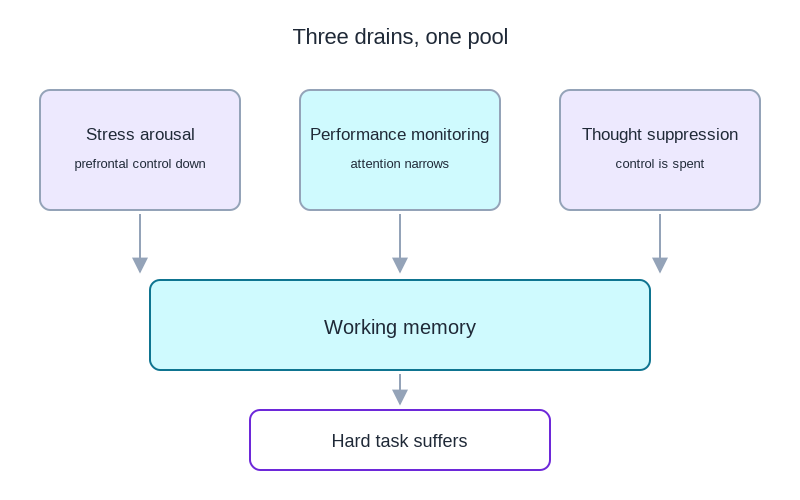
A hard test needs working memory, the limited system that holds and works with information during reasoning. Learn more about it in our guide to short-term and working memory. Stereotype threat taxes that same system through three drains that combine into one bottleneck.
First, a stress response impairs prefrontal processing, the brain basis of executive control. Second, performance monitoring narrows attention: the student scans for signs of failure instead of working the problem. Third, effortful suppression fights the anxious thoughts the threat provokes, which keeps them active and costs control. A 2008 review of the experimental, cognitive and physiological evidence pulls these three processes into one integrated model.
Beilock, Rydell and McConnell tested the bottleneck directly in 2007 with modular arithmetic problems. Under threat, only the problems that leaned heavily on working memory failed, above all the ones that taxed verbal resources. Practice that moved a problem into direct retrieval removed the effect. The same study found spillover: after the threatened math task, students did worse on a verbal task that shared the same resources, but not on a spatial one.
Threat, lift and boost: how the three differ
Not every stereotype cue harms. The literature names three directions, and students mix them up. The table sorts them.
| Situation | What happens to performance | Example |
|---|---|---|
| Stereotype threat | A negative stereotype about your group lowers your score | Women told a hard math test shows gender differences trail equally qualified men |
| Stereotype lift | A negative stereotype about another group raises your score | Performance rises when the comparison group is stereotyped as weaker |
| Stereotype boost | A positive stereotype about your group raises your score | Asian women reminded of their Asian identity outscore those reminded of gender |
Shih, Pittinsky and Ambady showed the crossover in 1999 with Asian American women and a hard math test. Prompted about gender, they solved 43 percent of items against 49 percent in the neutral group. Prompted about Asian identity, they reached 54 percent. Stone and colleagues carried the effect into sport the same year. Framing golf as a test of athletic ability lowered White players, while framing it as strategic thinking lowered Black players. Each group fell where its negative stereotype pointed.
Keep the terms from this post
Look them up in Psychology World, save them to a list and study them.
What lowers the threat
Researchers have tested five practices. Each has some support, and each comes with a caveat from later reruns. Treat them as studied classroom practices, not guarantees.
- Teach the effect itself. In one study of women's math performance, explaining the phenomenon beforehand removed the usual gap. But a later calculus study found the opposite: women who fully grasped the information did worse. How the message frames the student matters: re-attribution to an outside cause helps, while feeling marked as a target hurts.
- Teach a growth mindset. Students who view ability as expandable through effort treat a poor result as temporary, which takes force from the stereotype. Later large-scale attempts found smaller and more variable effects than the first studies. Our guide to growth and fixed mindset explains the distinction.
- Use values affirmation. In randomized field work, seventh graders wrote about personally important values, and Black students' grades rose enough to cut the racial gap by roughly 40 percent, mostly among previously low performers. Well-powered reruns in other settings found small or null effects, though one large English trial with low-income pupils found gains. The effect looks setting-dependent.
- Show counter-stereotypical role models. College women who first read about women who succeeded in architecture, law, medicine and invention did better on a hard math test than controls. The examples weaken the stereotype's relevance.
- Build identity-safe framing. Describe tests as learning exercises rather than verdicts on ability, move demographic questions to the end, and mix cues of belonging. Walton and Spencer showed that grades and test scores can systematically underestimate stereotyped students' true skill, which is why fair framing matters beyond the classroom.
Ordinary test anxiety overlaps with these practices, but it lacks the group-stereotype cue that defines threat.
What the big replications found
The honest verdict is mixed and contested. The effect is real in some laboratory settings, smaller than early reports claimed, and unable to carry real-world gaps on its own.
Two results carry the most weight. Flore, Mulder and Wicherts ran a registered report with 2,064 Dutch high-school pupils in 2018. They tested the gender-math paradigm with four predicted moderators and found neither an overall effect nor any moderated effect. Most variation in scores came from gender, domain identification and math identification.
The authors limit the finding to Dutch pupils aged 13 to 14 and mathematics. Shewach, Sackett and Quint meta-analyzed cognitive-ability experiments in 2019 and restricted the pool to settings that resemble real testing. There the pooled estimate ran from essentially zero to d = -.14, with clear signs of publication bias. Small studies with large effects were overrepresented, and correction shrank the estimate toward zero. A 2015 meta-analysis of the gender-math literature reached the same warning.
None of this erases the laboratory work. A 2008 meta-analysis found reliable small-to-moderate effects that varied by moderator: subtle cues, such as being the only woman in the room, tended to produce the largest effects for women. Reviews of age-based and immigrant samples also find small effects that survive scrutiny. The modern picture is a modest, setting-dependent phenomenon. It is genuine under some conditions and heterogeneous across them. It adds a small factor next to the structural forces behind achievement gaps, such as schooling, resources and preparation.
A one-question test for any example
Use this test on any case you meet in class. Ask: would the performance change if the same task stopped measuring the stereotyped ability. If yes, suspect stereotype threat. If no, look elsewhere.
Run three checks with it. First, name the group, the negative stereotype and the domain: who fears confirming what, and where. Second, check difficulty and framing: threat strikes hard, diagnostic tasks at the edge of skill, not easy drills.
Third, rule out the neighbours. Prejudice is an attitude and discrimination is behaviour, not a performance dip under evaluation. A self-fulfilling prophecy starts from someone's expectation and shapes behaviour toward it, while threat starts from the student's own fear of confirming a stereotype. Ordinary anxiety has no group cue at all.
When you meet a term like this in class, look it up and save it to a list for the course. Drill the list with Flashcard and Question, then type the answers with Typing. Search inside definitions and study progress are Pro features that speed up review. The word of the day brings one term each day at a time you choose, and it stays off until you turn it on. The app runs on iPhone and iPad. To build the habit, drill the term with flashcards.
Keep the terms from this post
Look them up in Psychology World, save them to a list and study them.
Frequently asked questions
What is stereotype threat in simple terms?
It is the fear that your result will prove a negative stereotype about your group right. That fear distracts you and uses up working memory, so you score below what you know. It needs no belief in the stereotype and fades when the test stops feeling diagnostic.
What is an example of stereotype threat?
Black students told a hard verbal test measures ability underperform equally prepared White students, while the same items framed as practice close the gap. Women told a hard math test shows gender differences trail equally qualified men, while a gender-fair framing of the same test removes the gap.
How does stereotype threat affect performance?
Through three drains on one pool: stress arousal impairs prefrontal control, monitoring for failure disrupts fluent work, and suppressing worried thoughts consumes the same working memory a hard task needs. Easy or well-practised tasks survive because they lean less on that pool.
How can stereotype threat be reduced?
Studied practices include teaching students about the effect so they re-attribute anxiety. They also include teaching that ability grows with effort, brief values-affirmation writing, counter-stereotypical role models, and identity-safe framing such as describing tests as practice. Later reruns find smaller and setting-dependent effects, so none is a guaranteed fix.
What is the difference between stereotype threat and self-fulfilling prophecy?
Stereotype threat starts from the student's own fear of confirming a negative group stereotype during evaluation, and it lowers the threatened student's score. A self-fulfilling prophecy starts from someone's expectation, teacher or student, and behaviour bends toward that expectation across many settings, not only tests.
Does stereotype threat explain real test score gaps?
Only a small part at most. In test-like settings the pooled estimate runs from zero to d = -.14 with publication bias present, and the largest registered classroom study found no effect. Structural differences in schooling, resources and preparation carry far more of the real gaps.
Sources
- Schmader, Johns and Forbes (2008). An integrated process model of stereotype threat effects on performance.
- Brooks (2024). Defining stereotype threat and why it matters.
- Steele and Aronson (1995). Stereotype threat and the intellectual test performance of African Americans.
- Flore, Mulder and Wicherts (2018). The influence of gender stereotype threat on mathematics test scores of Dutch high school students: a registered report.
- Spencer, Steele and Quinn (1999). Stereotype threat and women's math performance: summary.
- Beilock, Rydell and McConnell (2007). Stereotype threat and working memory: mechanisms, alleviation, and spillover.
- Simply Psychology (2026). Stereotype threat.
- Wikipedia (2026). Stereotype threat.
- University of Colorado (2026). Stereotype threat: teaching guide.