Studying
Test anxiety: why exams blank your memory, and what actually helps
 Yusuf DemirciContent Writer at Psychology World
Published 25 Nov 2026 · 8 min read
On this page
Please note
Psychology World is an educational reference, not diagnosis or treatment. If you need help, talk to a doctor or a qualified professional.
Test anxiety is the worry and physical tension you feel before or during an exam. It blanks your memory because anxious thoughts compete with the test for the same limited working memory. Roughly one student in six feels it strongly, and three techniques have experimental support: writing your worries down before the test, reappraising arousal as helpful, and practicing under test conditions.
- Test anxiety has two parts: worry (thoughts about failing) and emotionality (racing heart, nausea). The thoughts predict scores; the body symptoms alone do not.
- Blanking happens when worry uses up working memory, the scratch pad that holds the question while you answer it.
- Newer research adds two drivers: distracting off-task thoughts and low confidence, not worry alone.
- Writing worries for 10 minutes before an exam raised highly anxious students from B- to B+ in one study.
- Telling yourself arousal helps raised math scores in a small lab and real-exam follow-up.
- Frequent low-stakes practice tests cut test anxiety to a medium extent across 25 studies.
- If anxiety regularly causes panic, avoidance, or major impairment, talk to a school counselor or a doctor.
Keep the terms from this post
Look them up in Psychology World, save them to a list and study them.

What test anxiety is
Test anxiety is a pattern of worry and bodily arousal tied to exams. Psychologists split it into two parts. Worry means thoughts about failing, such as "I will blank on every question." Emotionality means the body's alarm: pounding heart, sweating, nausea, shaking.
| Worry | Emotionality | |
|---|---|---|
| What it is | Thoughts about failing and its consequences | Bodily alarm during the test |
| Example | "Everyone else finds this easy" | Pounding heart, nausea |
| Link to scores | Stronger; predicts lower performance | Weak alone; matters with high worry |
The split matters because the two parts behave differently. In a study of 168 undergraduates, higher cognitive anxiety came with lower scores on all three course exams (Cassady & Johnson, 2002). Bodily arousal alone did not carry the same link. Three meta-analyses reach the same verdict (Hembree, 1988; Seipp, 1991; von der Embse et al., 2018, via Schillinger et al., 2021). The cognitive side relates to performance more strongly than the physical side.
Test anxiety sits on a continuum. There is no sharp line between "has it" and "does not." In English secondary schools, high test anxiety runs from 12 to 18 percent (Putwain & Daly, 2014, via Ofqual, 2020). That is about five students in a class of thirty, with girls reporting it more often than boys. Milder forms are far more common. In PISA 2015, 72 percent of UK fifteen-year-olds said they still feel anxious even when well prepared for a test (OECD, 2017, via Ofqual, 2020). The global average was 56 percent.
Why anxiety blanks your memory
Working memory is the mind's scratch pad. It holds the question in mind while you pull up the answer and work through it. It is small, and everything you hold there competes for the same space.
Anxiety spends that space on threat. According to attentional control theory, anxiety weakens the goal-directed attention system and strengthens the stimulus-driven one, so attention slides from the task to the worry (Eysenck et al., 2007). Two control functions suffer most: inhibition, which resists distraction, and shifting, which moves focus back to the task. Anxious students notice more distractors and return to the question more slowly.
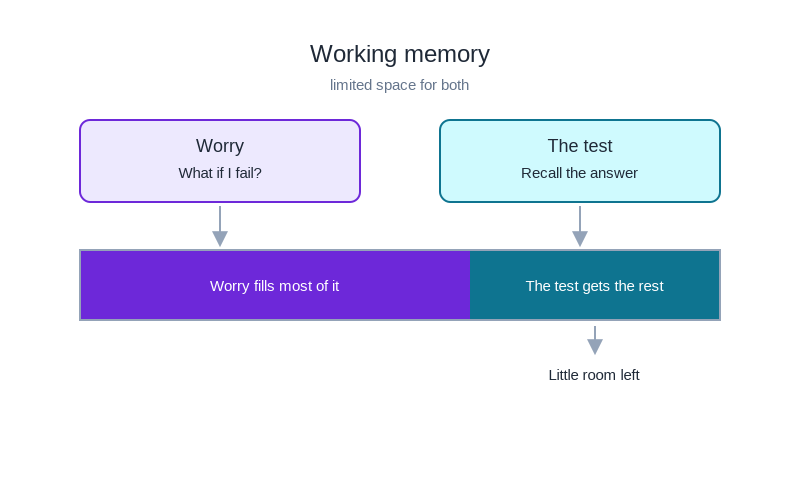
That is why the blank feels so specific. You studied, the knowledge is stored, but at the desk the scratch pad is full of "what if I fail." Recall needs that pad free. When worry fills it, the answer cannot come out, which feeds more worry. Students describe exactly this loop: reading a paragraph and absorbing nothing, then racing thoughts during the test itself.
A 2021 study of 730 university students revises the classic story in one honest way. Worry, distracting off-task thoughts, and low confidence each correlated with scores. But in the full model, only interference and lack of confidence explained unique variance — worry alone did not (Schillinger et al., 2021). So the practical targets are broader than "stop worrying": clear the distracting thoughts and build genuine confidence through preparation. Both threads run through the techniques below.
Keep the terms from this post
Look them up in Psychology World, save them to a list and study them.
Three things that measurably help
Most advice pages list the same tips. These three earned their place in experiments, with the caveats stated.
- Write your worries for 10 minutes before the test. In lab and classroom experiments, students who wrote about their test-related thoughts beat controls who sat quietly: the control group dropped 12 percent under pressure while writers gained 5 percent, and highly anxious ninth-graders scored B+ instead of B- on a real biology final (Ramirez & Beilock, 2011). Writing unloads the worries that occupy working memory, freeing the scratch pad for the test (Beilock, via UChicago News, 2011). Use plain sentences about what scares you. It helped the most anxious students most, and samples were small, so treat it as promising rather than proven.
- Reappraise the arousal as fuel. Students told that arousal helps performance — "if you feel anxious, remind yourself it could be helping you" — outscored controls on practice and real graduate-entrance math sections, 770 to 706 on the real test (Jamieson et al., 2010). The racing heart is your body mobilizing resources; calling it excitement instead of fear changes what you do with it. One small study, math only, no verbal effect: a useful reframe, not a guarantee.
- Practice under test conditions, often and without stakes. A meta-analysis of 25 effects in 3,374 participants found practice tests cut test anxiety to a medium extent, with strong Bayesian evidence and little publication bias; easier practice tests calmed more than hard ones (Yang et al., 2023). In a survey of 1,408 middle and high school students, 72 percent said retrieval practice made them less nervous for unit tests and exams (Agarwal et al., 2014). The first retrieval should never be the final itself: quiz yourself weekly from memory, then check (Agarwal, 2024). Note the nuance: quizzes themselves can feel stressful, so keep them low-stakes and start easy.
Breathing exercises, sleep, and exercise appear on every list and do no harm. Their direct evidence against test anxiety is thinner than for the three above. Give them supporting roles: a short walk, a regular sleep window in exam week, and slow breathing at the desk when symptoms spike.
Prepare so there is less to fear
Confidence is half the mechanism. Students who know the material trust the scratch pad, and the worry loop has less to feed on. Preparation is therefore an anxiety intervention, not just a grades one.
Spread study over days instead of cramming the night before. Spacing works because each session forces retrieval after partial forgetting, which strengthens the trace (see how spaced repetition beats cramming). Test yourself from memory rather than rereading: close the book, write what you remember, then check the gaps (see why testing yourself works). If you start late, fix the planning, not your character: last-minute rushes come from avoidance loops with known exits (see why putting things off is not laziness). Study in timed 25-minute blocks with real breaks to keep sessions honest (see study in 25-minute sessions).
Psychology World fits this routine. Look up each term, save it to a list for the course, and drill the list with the Flashcard, Question and Typing games. Search inside definitions and study progress are Pro features that show which terms still need work. The word of the day brings one term each day at a time you choose, and it stays off until you turn it on. The app runs on iPhone and iPad.
When tips are not enough
Study techniques handle normal nerves. They do not handle everything. If anxiety regularly causes panic before exams, skipping tests or classes, or weeks of impaired sleep, appetite, or daily life, talk to a school counselor, a therapist, or a doctor. They can tell an exam-hall problem from a broader anxiety problem and suggest what fits. Asking is not weakness; it is the same move as checking the gaps after a practice test.
Keep the terms from this post
Look them up in Psychology World, save them to a list and study them.
Frequently asked questions
Is test anxiety normal?
Yes, in mild form. Most students feel some tension before exams, and UK data show nearly three-quarters of fifteen-year-olds feel anxious even when prepared. It becomes a problem when it regularly lowers scores, or brings panic and avoidance.
Why do I blank on tests I studied for?
Because recall needs free working memory, and worry occupies it. The knowledge is stored, but anxious thoughts about failing fill the scratch pad that pulls answers out. Unloading the thoughts and preparing through retrieval both free it.
Does writing about worries really work?
In two lab and two field experiments, 10 minutes of writing about test thoughts raised scores for highly anxious students and erased their gap with calmer peers (Ramirez & Beilock, 2011). Samples were small and effects clearest for the most anxious, so treat it as the best-supported quick technique, not magic.
Do practice tests increase anxiety instead?
Low-stakes ones reduce it. Across 25 studies, practice tests cut test anxiety to a medium extent (Yang et al., 2023). And 72 percent of surveyed school students felt less nervous after weekly retrieval practice (Agarwal et al., 2014). Keep quizzes ungraded and start easy; graded mock pressure is a different tool.
Is test anxiety a diagnosis?
No formal cut-off defines it. Researchers treat it as a continuum from calm to highly anxious, and prevalence figures depend on where a study draws the line. Severe exam-related impairment still deserves professional attention whatever it is called.
When should I get help?
When anxiety brings panic attacks, test avoidance, or lasting effects on sleep, mood, or daily functioning. A school counselor is the fastest first door; a therapist or doctor comes next. Study tips cannot replace that conversation.
Sources
- Schillinger, F. L., et al. (2021). Revisiting the role of worries in explaining the link between test anxiety and test performance.
- Cassady, J. C., & Johnson, R. E. (2002). Cognitive test anxiety and academic performance.
- Eysenck, M. W., et al. (2007). Anxiety and cognitive performance: Attentional control theory.
- Ofqual (2020). A review of the literature concerning anxiety for educational assessments.
- University of Chicago News (2011). Writing about worries eases anxiety and improves test performance.
- Jamieson, J. P., et al. (2010). Turning the knots in your stomach into bows: Reappraising arousal improves performance on the GRE.
- Yang, C., et al. (2023). Do practice tests reduce or provoke test anxiety? A meta-analytic review.
- Agarwal, P. K., et al. (2014). Classroom-based programs of retrieval practice reduce test anxiety.
- Agarwal, P. K. (2024). Practical tips to reduce student test anxiety.