Studying
Elaborative interrogation: why asking why helps you remember
 Yusuf DemirciContent Writer at Psychology World
Published 23 Nov 2026 · 9 min read
On this page
Please note
Psychology World is an educational reference, not diagnosis or treatment. If you need help, talk to a doctor or a qualified professional.
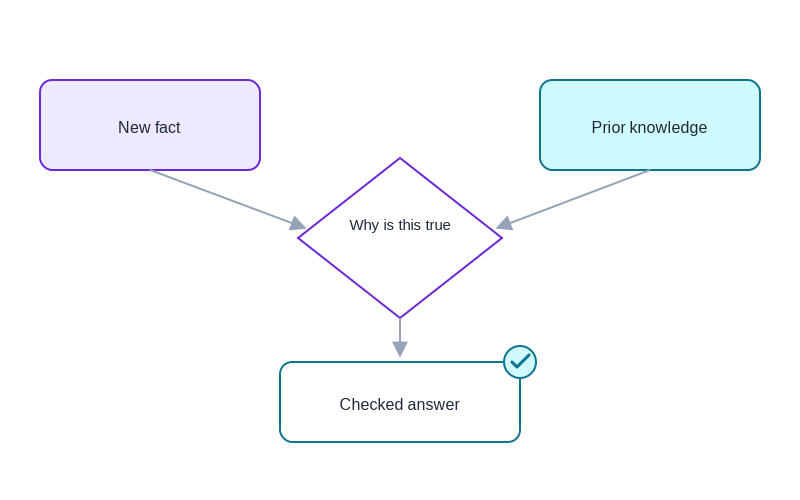
Elaborative interrogation means asking why a stated fact is true and answering the question from what you already know. A student reads a fact, asks why it makes sense, and builds a short answer that links the new fact to known ideas.
A large review of study methods gives this method a middle rating. Practice testing and spreading study over time rank higher, while rereading and highlighting rank lower. Elaborative interrogation sits between them: it helps, but the support comes mostly from short lab studies with facts. This article shows what it is, why it helps, how to use it, and when to choose another method.
- Elaborative interrogation is a why-question about one fact, answered in your own words.
- Prompted answers beat given answers and simple rereading for recall of facts.
- It works best when you already know something about the topic.
- It suits single facts and short passages, not whole chapters at once.
- Always check your answer against a trusted source, because a wrong answer can harm learning.
Keep the terms from this post
Look them up in Psychology World, save them to a list and study them.

What elaborative interrogation is
Elaborative interrogation is a study prompt, not a test of knowledge. You take one stated fact and ask why it is true. Then you answer in one or two sentences.
Use three prompts. Ask why is this true. Ask why does it make sense that this holds. Ask why would this hold for this case and not for another case. A teaching guide from the University of Wisconsin La Crosse lists these prompts as the core of the method. It notes that the aim is to discern links and differences between ideas (Cerbin, 2015).
Take a psychology fact. Maintenance rehearsal keeps an item active by repetition, while elaborative rehearsal links it to meaning. Ask why the second form supports later recall and the first form does not. A good answer notes that links to meaning give later recall more paths, while repetition alone adds no new paths. Then check the entry for each term and fix what you missed.
The method comes from work on fact learning in the 1980s. Students who generated their own why-answers recalled more than students who only read the fact or who received a ready-made answer (Pressley and colleagues, 1987, summarized in Northeastern CATLR, 2018). The gain rests on the act of generating, not on reading an explanation.
Why asking why helps
New facts stick when they join known facts. Asking why forces that join. You search memory for a reason, you select what fits, and you store the new fact with the old one.
A review of learning science describes elaboration as connecting new input to prior knowledge, which adds features to memory and aids later recall (Weinstein and colleagues, 2018). The same review names elaborative interrogation as a technique with relatively strong support: students ask how and why questions about what they study and then try to answer them.
A second path is order. Linked ideas form a small structure instead of a loose list. At recall time the structure guides the search. This matches older work on depth of processing, where meaning-based processing supports memory better than surface repetition. For background on that principle, read about deeper processing of meaning.
The effect is clearest for cued recall and recognition of facts. Results for free recall and for deep comprehension are mixed. Most studies use short lists and test soon after study. Treat the method as a tool for facts, not as proof of full understanding.
How to use elaborative interrogation in 5 steps
Use the method on one fact at a time. Keep each round short.
- Pick one stated fact from your notes. Choose a single sentence, such as elaborative rehearsal links new facts to meaning.
- Ask why it is true. Say the question aloud in full, such as why links to meaning would aid later recall more than mere repetition.
- Answer from what you already know. Write one or two sentences without looking, linking to a known idea such as paths that aid later search.
- Check the answer against a trusted source. Open the source you study from, compare each part, and correct errors at once. A review warns that poor self-made content can harm learning when left unchecked (Weinstein and colleagues, 2018).
- Retrieve it again later. Cover the answer and test yourself after you explain, since recall tests memory harder than recognition. Return to the card on another day.
Work an example for a psychology term. Read the term, close the entry, ask why the definition holds, answer, then open the entry and fix gaps. For terms that pair up, ask the contrast form: why does this hold for this term and not for the other term. This contrast step often reveals the exact feature exams test.
Use the method often but briefly. A classroom guide reports that prompts work best when they recur across a passage and when students explain single ideas rather than long sections (Cerbin, 2015). In one biology class, students who received 21 why-prompts through a passage scored 76 percent on a later test against 69 percent for students who studied as usual.
Keep the terms from this post
Look them up in Psychology World, save them to a list and study them.
When it works best and when it does not
A 2013 review of ten study methods rates elaborative interrogation as moderate utility, below practice testing and distributed practice and above rereading and highlighting (Dunlosky and colleagues, 2013). The reason for the middle rating is thin classroom proof: few studies test it in real courses or over long intervals.
| Situation | Use it | Why |
|---|---|---|
| You know the topic basics | Yes | Prior knowledge supplies material for a good answer |
| You meet a new field with no base | Wait | Without base ideas you cannot build a sound answer |
| One fact or short passage | Yes | The prompt fits a single claim |
| A whole chapter at once | No | Break the chapter into single claims first |
| Cued recall and recognition | Yes | Strongest support sits here |
| Free recall and transfer | With care | Evidence is mixed, so pair with practice testing |
| Exam in days with time to check | Yes | Checking keeps errors out |
| Rush with no source to check | No | An unchecked wrong answer can stick |
Background knowledge decides much. A summary of the review notes that learners with no relevant base find the prompt hard to use. Learners with growing knowledge find it easier and gain more (Dunlosky, 2013). Start with familiar topics, then move to harder ones.
Length matters too. The same summary notes that most work tests single facts, and that asking why about facts in class still aids learning even when the facts sit in longer talk. Keep the unit small: one claim, one why, one check.
For a study plan that mixes methods, pair this tool with mixing topics while you interrogate. Ask why for one kind of item, then switch kind, then return. The switch trains you to pick the right idea, not only to repeat one idea.
Neighbours to keep apart
Four methods sound alike and act unlike. The table sorts them.
| Method | What you do | Test that sorts it |
|---|---|---|
| Elaborative interrogation | Generate a why-answer for a stated fact | Ask: did you answer why this stated fact is true |
| Self-explanation | Explain how new input links to known input, or why you took each step | Ask: did you explain steps and links while working |
| Elaborative rehearsal | Restate an item in meaningful form to hold it | Ask: did you restate to hold it, without a why-answer |
| Summarising | Restate main points briefly | Ask: did you shorten without adding a reason |
Self-explanation overlaps most. Both link new to known. The prompt differs: interrogation asks why a given fact holds, while self-explanation asks how each part links to what you know and why each step was taken. For detail on the rehearsal side, see how elaborative rehearsal differs from interrogation.
A one-question test sorts most cases. If you can point to the why-question you answered, the round was interrogation. If you only repeated or shortened, it was rehearsal or a summary.
Do not count a paraphrase as an explanation. Teaching guides stress modelling the difference, because students who only reword gain little. An explanation adds a reason. A paraphrase changes words.
What this means for psychology terms
Psychology courses test terms in pairs and in cases. Why-questions fit that test form. For each term, ask why its key feature holds and why its neighbour differs.
Build one list for the method. Add terms that confuse you, such as framing and loss aversion, or rehearsal forms. For each card, write the fact on the front and your why-answer on the back. Study the list in short rounds across days. For a full routine for term lists, use the guide to memorising psychology terms.
A dictionary app fits this loop where lookup meets drill. Look up a term, save it to a named list, then turn the list into rounds. On iPhone and iPad, Psychology World lets you save terms to lists and drill a list with Flashcard, Question, and Typing games. Question opens once a list holds four or more words. Ask why for each card first, check the entry, then drill until recall is quick.
Keep the terms from this post
Look them up in Psychology World, save them to a list and study them.
Frequently asked questions
What is elaborative interrogation in simple terms
It is the habit of asking why a stated fact is true and answering from what you already know. You read one claim, you ask why it makes sense, you write a short reason, and you check it.
Does elaborative interrogation work for exams
It aids recall of facts in lab studies, with a middle rating in a 2013 review because classroom and long-term proof is thin. Use it for facts you must recall, pair it with self-testing, and spread rounds over days.
What is an example of elaborative interrogation
Take the claim that elaborative rehearsal beats maintenance rehearsal for later recall. Ask why links to meaning would beat mere repetition. Answer that links add paths for later search. Then check a trusted source and fix gaps.
Is elaborative interrogation the same as self-explanation
No. Interrogation asks why a given fact holds. Self-explanation asks how new input relates to known input and why each step in a task was taken. Both link new to known, but the prompts and the best use differ.
Is elaborative interrogation the same as elaborative rehearsal
No. Rehearsal restates an item in meaningful form to hold it in mind. Interrogation generates a reason why the fact holds. Rehearsal holds, interrogation explains.
Why does elaborative interrogation fail without background knowledge
Without base ideas you cannot build a sound reason, so answers stay vague or wrong. Start with familiar topics, keep to single facts, and always check against a source.
Sources
- John Dunlosky (2013). Strengthening the Student Toolbox.
- Dunlosky, Rawson, Marsh, Nathan and Willingham (2013). Improving Students Learning With Effective Learning Techniques.
- Weinstein, Madan and Sumeracki (2018). Teaching the science of learning.
- Northeastern CATLR (2018). The Power of Self-Explanation.
- Cerbin (2015). Elaborative interrogation, UWLAX Teaching Improvement Guide.