Studying
SQ3R: the five steps that turn reading into studying
 Yusuf DemirciContent Writer at Psychology World
Published 25 Nov 2026 · 9 min read
On this page
Please note
Psychology World is an educational reference, not diagnosis or treatment. If you need help, talk to a doctor or a qualified professional.
SQ3R stands for Survey, Question, Read, Recite and Review. It is a reading method that turns one passive pass through a chapter into five active moves. Francis P. Robinson described it in Effective Study, first published in 1941 with a 1946 edition.
You scan the chapter first, turn its headings into questions, read to answer them, say the answers back from memory, and review your notes later. This article shows how to run the SQ3R study method step by step, what research says about it, and how to use it for psychology terms.
- SQ3R means survey, question, read, recite, review: scan first, question the headings, read for answers, recite from memory, review later.
- Robinson introduced the method in the 1940s, and university guides still teach the same five steps.
- The full routine has thin direct support, but its read-recite-review core beat note-taking and re-reading in a 2009 study.
- Recite with the page closed, write questions worth answering, and spread review over days.
- For terms, recite each term in your own words, save it to a list, and drill that list until it sticks.
Keep the terms from this post
Look them up in Psychology World, save them to a list and study them.

What does each letter of SQ3R mean
The five letters name five moves in fixed order. Survey and Question prepare the reading, Read does it, Recite checks it, and Review keeps it.
| Letter | Step | What you do |
|---|---|---|
| S | Survey | Scan the title, headings, figures, summary and end questions before reading. |
| Q | Question | Turn each heading into one or more written questions. |
| R | Read | Read to answer those questions, for meaning and not only for answers. |
| R | Recite | Say or write the answers from memory, in your own words. |
| R | Review | Revisit your notes and questions later, more than once. |
Two naming variants appear in study guides. Some guides write Recall instead of Recite, and some write Skim or Query instead of Survey or Question. This article uses Survey, Question, Read, Recite and Review throughout, which is the wording university guides and encyclopedias use. The meaning stays the same under either name: look before reading, ask before reading, answer while reading, recall after reading, revisit later.
How do you run the five steps
Take one chapter and work it in order. The example below uses a psychology chapter on memory, but the moves fit any dense text.
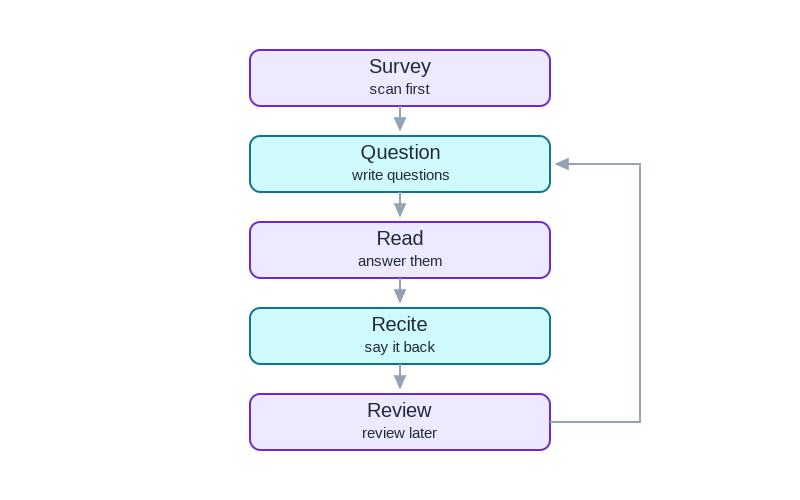
- Survey the chapter in three to five minutes. Read the title, the headings and subheadings, the intro and summary, the figures and their captions, and the questions at the end. Note the terms that repeat. Do not start reading yet.
- Write one or two questions per heading. Turn "The multi-store model" into "What are the three stores, and what moves information between them". Turn "Forgetting" into "What causes forgetting besides decay". Write the questions down. Good questions ask about causes, differences and uses, the same habit that asking why a fact is true builds.
- Read one section at a time to answer its questions. Keep the current question in mind and mark where the text answers it. Read for meaning, not only for the answer sentence.
- Close the page and recite. Say the answer aloud or write it without looking, using your own words. Name each key term and define it as if teaching it, the same move that explain it in plain words practices. This is active recall from memory: retrieval, not re-reading, is what builds the trace.
- Review within a day, then again over the coming days. Re-read your questions, answers and notes, and recite the weak ones again. Spacing works because memory fades fast without it, as how information is lost without review shows, and spacing review over days keeps it longer. Short sessions help here: work through the steps in 25-minute study sessions instead of one long sitting.
Stanford's study guide gives the same advice in shorter form. Go through the steps in order at first, then adapt them to your own purposes and style once the habit holds.
Keep the terms from this post
Look them up in Psychology World, save them to a list and study them.
What does research say about SQ3R
The honest answer has two parts. The full five-step routine has little direct proof, while its core has solid proof.
Cognitive scientists who reviewed the method found very few published tests of SQ3R as a whole, and mixed results where tests exist. Part of the problem is inconsistency. Guides define Recite in different ways. Some ask readers to answer while looking at the page. Others ask for recall with the page closed.
Survey and Question also take training to do well. A method taught ten ways cannot show one clear effect.
The core, though, survived a clean test. In two experiments, McDaniel, Howard and Einstein asked students to read passages, then compared three follow-ups: a read-recite-review routine, note-taking while reading, and plain re-reading. In the 3R condition students read the passage, recited all they could remember into a tape recorder, then read the passage again. The 3R group recalled more than both other groups and answered inference questions better than the re-readers, while working faster than the note-takers. The Learning Scientists summarize the lesson plainly: reciting is retrieval practice, and reviewing adds feedback or spacing depending on when it happens.
So treat the first two letters as preparation and the last three as the engine. Survey builds the map, Question aims attention, and Read-Recite-Review does the learning. If time is short, keep the engine: read, recite from memory, review later.
Which mistakes break the method
Most SQ3R failures come from four habits. Each has a simple fix.
- Skipping Recite and calling reading done. Reading feels fluent, so the material feels learned. Fix it by closing the page every section and saying the answer before moving on. No recall, no credit.
- Writing weak questions. "What is this section about" accepts any vague answer. Fix it with specific questions: what causes it, how does it differ from its neighbour, when does it fail. One sharp question beats three dull ones.
- Answering while looking. Peeking turns Recite into copying. Fix it by writing the answer first, then checking the text. What you missed is your next review set.
- Reviewing once or never. One pass fades within days. Fix it by booking two short revisits: tomorrow and later in the week. Each revisit starts with reciting, not re-reading.
Low motivation also hurts, because Question and Recite demand effort that skimming avoids. Shorter texts help at the start: run the full routine on one section before running it on a chapter.
How does SQ3R compare with nearby methods
Students mix SQ3R up with four neighbours. Each neighbour owns one part of the job, while SQ3R chains them into a chapter routine.
| Method | What it is | When to reach for it |
|---|---|---|
| SQ3R (this guide) | A five-step chapter routine: scan, question, read, recite, review. | Facing a new chapter and needing a full pass. |
| Active recall | Testing yourself from memory instead of re-reading. | Turning any material into self-tests. |
| Spaced repetition | Spreading review over growing gaps. | Keeping learned terms for weeks. |
| Pomodoro | Working in timed focus blocks with breaks. | Pacing the five steps without fatigue. |
| Feynman | Explaining an idea in plain words until no gap remains. | Deepening the Recite step. |
| Elaborative interrogation | Asking why each fact is true. | Sharpening the Question step. |
In short: elaboration sharpens Question, active recall and Feynman deepen Recite, spacing schedules Review, and Pomodoro paces the whole loop. SQ3R vs active recall is therefore the wrong contest. SQ3R contains active recall at its centre and adds the steps around it.
How do you use SQ3R for psychology terms
Terms are where chapters leak. A chapter on memory easily holds twenty new names, and reading alone will not keep them. Run the routine with terms as the target.
Survey the chapter and circle every term you cannot define cold. Turn each heading into a question that forces a definition, such as "What moves information from short-term to long-term store". Read the section for the answer. Then close the page and recite the term and its definition in your own words, one by one. What survives reciting is known; what fails goes on the review list.
Save the failed terms to one named list for that chapter, for example "Memory 1". Drill the list the same day: flashcards, then multiple-choice once the list holds at least four words, then typing the answers out. Review the list a day later and again across the week, reciting before re-reading. When a chapter gives you ten new terms, looking each one up, saving it to a list and drilling that list turns one reading into lasting vocabulary.
Keep the terms from this post
Look them up in Psychology World, save them to a list and study them.
Frequently asked questions
Who created the SQ3R method
Francis P. Robinson described SQ3R in Effective Study, first published in 1941 with a 1946 edition. University study guides still teach the same five steps he set out.
What is SQ3R in simple terms
It is a way of reading that asks you to work before, during and after the text. You preview the structure, write questions from the headings, read to answer them, recall the answers without looking, and revisit your notes later.
What is the difference between Recite and Recall in SQ3R
There is none in practice. Recite is the older word from Robinson's method, while some modern guides write Recall. Both mean the same act: produce the answer from memory with the page closed, aloud or in writing.
How long does one SQ3R pass take
Survey takes three to five minutes per chapter. The other steps take as long as careful reading plus self-testing takes. Beginners spend more time at first, then move faster as questioning and reciting turn into habits.
Do you have to use all five steps every time
No. Use all five while learning the habit. Under time pressure, keep the tested core: read, recite from memory, review later. That trio beat note-taking and re-reading in the McDaniel study, while Survey and Question matter most for dense or unfamiliar chapters.
Can SQ3R help with definitions and terminology
Yes, when Recite targets terms directly. Recite each term and its definition in your own words, save misses to a list, drill the list, and review it over days. Retrieval plus spacing is exactly what terminology needs.