Studying
The Feynman technique: learn it by teaching it simply
 Yusuf DemirciContent Writer at Psychology World
Published 24 Nov 2026 · 9 min read
On this page
Please note
Psychology World is an educational reference, not diagnosis or treatment. If you need help, talk to a doctor or a qualified professional.
The Feynman technique is a four-step study loop. Pick one concept, explain it in plain words with your notes closed, return to the source wherever you stall, then simplify the explanation and test it on a new example. It is named after the physicist Richard Feynman, but he never described it: a study writer introduced the name in 2011. The loop works because explaining from memory forces retrieval, and hunting for gaps forces elaboration. Both moves rank among the best supported in learning science.
This article gives the four steps, the true story of the name, what the evidence actually supports, a worked example from psychology, and the cases where the method helps less.
- The technique diagnoses ignorance: each stall in your explanation marks something to relearn.
- The name comes from Scott H. Young in 2011, not from Feynman himself.
- Expecting to teach improves recall and organization, even when nobody is listening.
- Retrieval practice and elaboration carry the effect; rereading and highlighting do not.
- Flashcards and the Feynman technique complement each other: one finds the gaps, the other closes them.
Keep the terms from this post
Look them up in Psychology World, save them to a list and study them.

What the Feynman technique is
The method has four steps. Use them on one small concept at a time, for example one term or one theory, not a whole chapter.
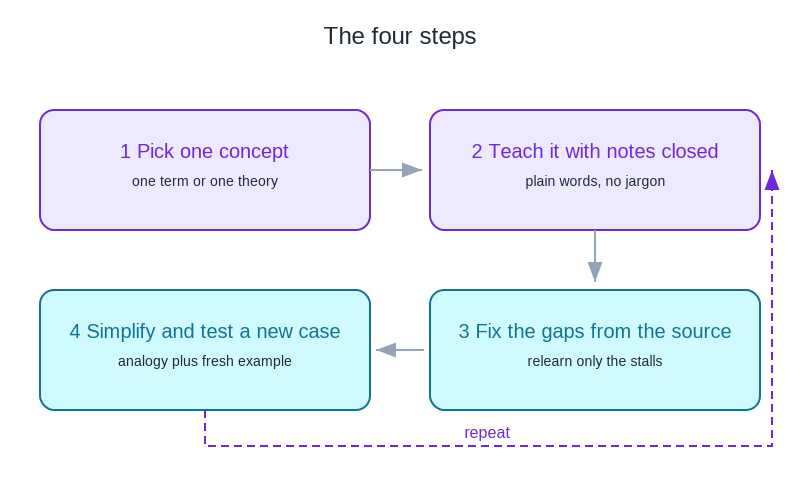
- Pick one concept. Write its name at the top of a blank page. Choose something narrow enough to explain on a single page. If the topic fills a chapter, split it first and start with one part.
- Teach it in plain words with your notes closed. Explain the concept as if to a beginner who knows none of the jargon. Write the explanation down or say it out loud. Do not look at the source until you finish. This step is a retrieval test: recalling the idea from memory is what strengthens it, and our article on active recall shows why that effort matters more than rereading.
- Mark every stall and return to the source. Underline each sentence where you hesitated, skipped a link, or used a term you cannot define. Turn each mark into a question, reopen the source, and relearn only those parts. Then close the source and explain the marked parts again from memory.
- Simplify the explanation and test it on a new example. Replace leftover jargon with short words, add an analogy that fits how the idea works, and use the explanation to answer a question you have not seen. If it fails, repeat from step 2. When it holds, keep the page and revisit it days later, which is where spaced repetition takes over.
Two details decide whether the loop works. First, the explanation must come from memory: notes open on the desk turn the exercise into copying. Second, the result needs a check: a real listener who asks questions is best, and an answer key or a second example works when you study alone.
Where the name really comes from
Writer Scott H. Young introduced the name in September 2011, in a post and video called Learn Faster with the Feynman Technique. The study blog Farnam Street popularized the four steps the next year. Richard Feynman himself never published or described such a method. The label honours his habits, not his instructions.
Two of those habits are well documented. As a Princeton graduate student preparing for his oral exams, Feynman opened a fresh notebook. He titled it Notebook Of Things I Don't Know About. Then he spent weeks taking each branch of physics apart and rebuilding it.
His Caltech colleague David Goodstein once asked him to explain a result in particle physics. Feynman promised a freshman lecture on it. Days later he returned: he could not reduce it to the freshman level, which meant he did not understand it.
One caution about quotations. People often credit Feynman or Einstein with the slogan that anyone who cannot explain an idea simply does not understand it. Researchers of the slogan's history found no source placing it with either man. Judge the method by its steps and its evidence, not by lines its namesake never wrote.
Feynman (1918–1988) shared the 1965 Nobel Prize in Physics with Julian Schwinger and Sin-Itiro Tomonaga. He studied at the Massachusetts Institute of Technology and took his PhD at Princeton. He taught at Cornell, then became a professor at the California Institute of Technology. Colleagues knew him as an unusually clear teacher.
Keep the terms from this post
Look them up in Psychology World, save them to a list and study them.
Why teaching yourself works
No trial has tested the packaged four steps against other methods directly. The evidence supports the parts, and the parts are doing the work.
The closest test changed only the expectation. In experiments at Washington University in St. Louis, one group of students read a passage expecting a test, while another group read it expecting to teach it to someone else. In the end everyone took tests and nobody taught. The students who had expected to teach recalled more of the passage, organized their recall more effectively, and answered more questions on the main points. Simply preparing as a teacher had pushed them to select key points and arrange them into a coherent structure.
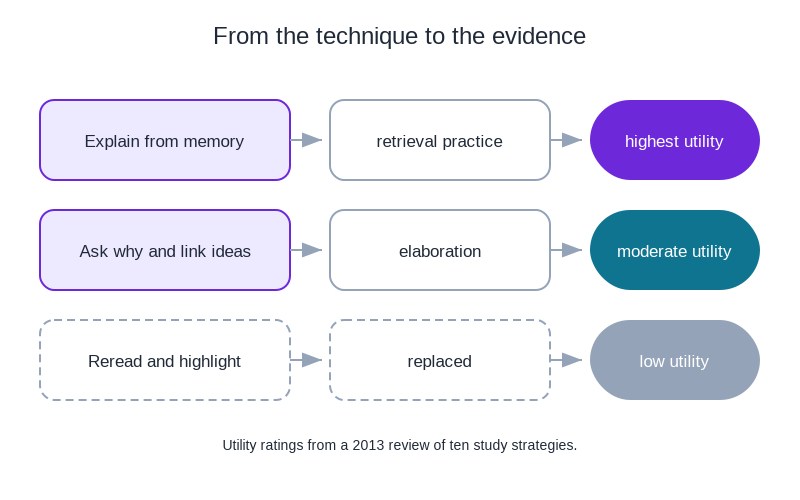
The two moves inside that preparation are old friends of learning science. Explaining from memory is retrieval practice: recalling an idea strengthens it far more than seeing it again. Asking why each link holds and connecting it to what you know is elaboration, the habit our article on elaborative interrogation teaches.
A major 2013 review of ten study strategies rated practice testing and distributed practice as the most effective across ages and materials, and rated elaborative interrogation and self-explanation as promising. The same review rated rereading and highlighting as weak: students who reread feel fluent without learning durably. The Feynman technique works because it replaces the two weakest habits with the strongest ones. It feels harder than rereading, and that difficulty is the point, as our article on desirable difficulties explains.
A worked example
Take classical conditioning, the form of learning in which a signal that meant nothing starts to trigger a response because it appeared together with something that already triggers that response. A bell means nothing to a dog. Food triggers salivation. After the bell sounds together with food several times, the bell alone triggers salivation. The signal borrowed the response.
Now run the loop on it. Step 1: classical conditioning. Step 2, from memory: learning where a neutral signal gains a response by pairing. Step 3: the stall arrives at one question. Why does the pairing transfer the response, rather than the dog simply reacting to two things at once? Back to the source: because the brain treats the bell as a predictor of food, so the prediction alone starts the response.
Step 4, simplified: pairing turns a signal into a forecast, and the forecast fires the response. Test it on a new case: a phone chime that always precedes a message will soon grab your attention by itself.
If the worked example raised terms you half know, our comparison of classical and operant conditioning defines each in full.
When it helps less
The method has four honest limits. First, it fits understanding, not pure lists. A university study guide warns that the technique is not suited to simple concepts or heavily memorization-based topics: explaining does not drill twenty drug names into memory.
Second, elaboration needs something to build on. Learners with no background in a topic struggle to generate explanations, so a first pass of the source must come first. Third, it costs time. Four careful passes over one concept take longer than a highlighter pass, which is why the method suits a few load-bearing ideas per session rather than everything.
Fourth, it needs a check. A listener who asks follow-up questions finds holes you glide past; without one, test the final explanation on a fresh example or against the answer key instead of declaring victory.
Feynman technique vs flashcards and active recall
The technique and flashcards answer different questions. The technique asks what you do not know yet. Flashcards drill what you must keep. Use the first to diagnose and the second to treat, and neither replaces the other.
| Situation | Use | Why |
|---|---|---|
| A concept feels familiar but slippery | The Feynman technique | Explaining exposes the exact link that is missing |
| Terms and facts must stick for weeks | Flashcards and practice tests | Repeated retrieval from memory builds durable recall |
| A whole topic mixes many ideas | Interleaving across sessions | Mixing problem types trains recognition, as our article on interleaving shows |
Psychology World defines 23,944 psychology terms for iPhone and iPad, and it fits the loop directly. Save the term you study to a list of your own. Then drill the list with the Flashcard, Question and Typing games. Each game asks you to recall terms from memory.
Search inside definitions and study progress are Pro features. A word of the day brings one term each day at a time you choose, and it stays off until you turn it on. For a companion routine that covers the whole exam period, our guide on how to memorize psychology terms lays out the full system.
Keep the terms from this post
Look them up in Psychology World, save them to a list and study them.
Frequently asked questions
Is the Feynman technique effective?
No trial has tested the packaged four steps directly, so no one can quote an effect size for the method itself. Its parts rest on strong evidence: expecting to teach improves recall and organization, retrieval practice beats rereading, and elaboration beats passive review. Treat it as a bundle of well-supported moves, not as a tested brand.
Who invented the Feynman technique?
Writer Scott H. Young introduced the name in 2011. The study blog Farnam Street spread the four steps in 2012. Richard Feynman never described such a method. The name honours his real habits: his notebook of things he did not know, and his rule about the freshman level.
Can I use it for any subject?
Yes, wherever understanding matters: sciences, mathematics, literature, and professional skills. It helps less for pure memorization lists with no logic to explain, such as twenty isolated names. For those, retrieval drills work better.
How long does it take?
One concept takes one focused session: a few minutes to explain, plus the source passes each gap needs. Difficult ideas take longer, and that extra time is the learning. Reserve the method for a few central ideas per study session rather than every page.
Can I use it alone, without a listener?
Yes. Write the explanation instead of speaking it, and check it against the source or a fresh example. A real listener is better because questions expose gaps you miss, but a written explanation rechecked from memory still forces retrieval and elaboration.
Is it better than flashcards?
Neither replaces the other. The technique finds the gaps in your understanding, and flashcards close the gaps in your memory. Explain a term first, then drill it with flashcards until recall is fast, then retest both days later.
Sources
- Scott H. Young (2011). Learn Faster with the Feynman Technique.
- NobelPrize.org. Richard P. Feynman – Biographical.
- Washington University in St. Louis (2014). Expecting to teach enhances learning, recall.
- John Dunlosky (2013). Strengthening the Student Toolbox: Study Strategies to Boost Learning.
- John Dunlosky et al. (2013). Strengthening the Student Toolbox (PDF).
- Farnam Street. Feynman Technique: The Ultimate Guide to Learning Anything Faster.
- University of York. The Feynman Technique.
- Todoist. How to Learn Anything with the Feynman Technique.
- Adobe. What is the Feynman Technique and why it works.
- University of Colorado Boulder. The Feynman Technique.
- MNMNOTE (2026). The Feynman Technique for Note-Taking.