Studying
Pomodoro technique: study in 25-minute sessions that stick
 Yusuf DemirciContent Writer at Psychology World
Published 24 Nov 2026 · 11 min read
On this page
Please note
Psychology World is an educational reference, not diagnosis or treatment. If you need help, talk to a doctor or a qualified professional.
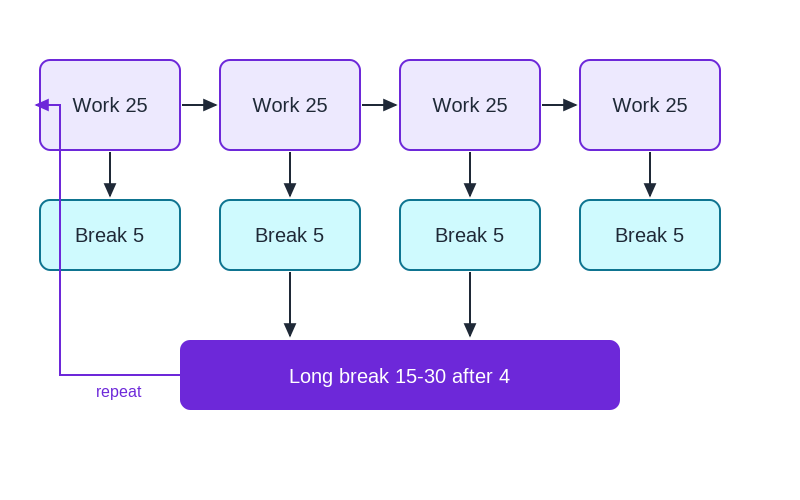
The Pomodoro technique splits study into 25-minute blocks of full focus, each followed by a 5-minute break. After four blocks, you take a longer break of 15 to 30 minutes. Francesco Cirillo, then a university student, built the method in the late 1980s. This article gives the exact steps, the three rules, what studies show, and a routine that fills each block with term practice.
- One pomodoro means 25 minutes on one task, then a 5-minute break; four in a row earn a 15 to 30-minute break.
- A started pomodoro never breaks: write down each interruption and return to it later.
- Structured intervals cut fatigue by about 20 percent in small trials, but they did not raise task output.
- Short blocks suit starting out, longer ones suit long readings, and breaks work best away from screens.
- Fill each block with recall practice on a saved term list, and spread blocks across days.
Keep the terms from this post
Look them up in Psychology World, save them to a list and study them.

What is the Pomodoro technique?
The Pomodoro technique is a time-management method that breaks work into short focused intervals with breaks between them. It uses a timer to mark 25-minute work periods, each separated by a short break. Each interval is known as a pomodoro, from the Italian word for tomato, after the tomato-shaped kitchen timer that Cirillo used while he was a university student. The Pomodoro Technique was invented in the late 1980s by Francesco Cirillo, a university student.
Cirillo built more than a timer habit. His system has three parts: plan the work, focus on one task at a time, and reflect on what the records show. You list the day's tasks and work through them one pomodoro at a time.
You mark each finished block. The marks turn time from a vague worry into a count of finished blocks, which makes the next day's plan more exact.
How do you run a Pomodoro session?
Follow these five steps. Each step is one action.
- Choose one task for the next 25 minutes.
- Set a timer for 25 minutes.
- Work on that task until the timer rings. Write down each distraction instead of acting on it.
- Mark the finished pomodoro on paper, then take a 5-minute break.
- Repeat the cycle. After four pomodoros, take a longer break of 15 to 30 minutes.
The steps come from student guides that universities publish for their own learners. Duke University tells students to define the task and set 25 minutes. Students then concentrate on that task alone, take a short break away from screens, and take the long break after four blocks. Oregon State adds the same core with a student note: decide the task first, fight off distractions during the block, and note each finished block before the break.
The break is part of the method, not a reward you may skip. Stand up, move, drink water, and rest your eyes from text. Screen scrolling on the phone will do less to restore you than a break with movement and rest.
What rules keep a pomodoro unbroken?
Three rules separate the technique from any timer habit. First, split a task that needs more than four pomodoros into smaller steps. A chapter becomes sections; a section becomes terms. Second, batch small tasks that each need less than one pomodoro. Short messages and quick lookups share one block.
Third, a started pomodoro must ring. A pomodoro is indivisible; when interrupted during a pomodoro, either the other activity must be recorded and postponed or the pomodoro must be abandoned. Finishing early does not end the block either. When the task is done before the timer rings, use the leftover minutes to review the same material. Mark the block when it rings.
Handle interruptions with a fixed routine: note the request, return to the task, and deal with the note in a later break. The routine has four moves: inform, negotiate, schedule, and call back. A message gets a written note, not an answer. The note waits until the break. This rule protects attention, because each glance at a phone costs far more than its seconds.
Tracking is the quiet third rule behind the three. Mark each finished block next to its task. Over a week, the marks show how many blocks a task type really needs. That record counters the planning error most students know: we underestimate study time (planning fallacy), even when past tasks ran long. Counts replace guesses.
What do studies show?
A 2025 scoping review gathered 32 studies with 5,270 learners in total. Across three randomized trials with 87 learners, structured Pomodoro intervals led to about 20 percent lower fatigue. The same trials showed a 0.5-point improvement in distractibility and a 0.4-point increase in motivation compared to self-paced break schedules. The five quasi-experimental studies reported 15 to 25 percent higher self-rated focus and roughly 20 percent less fatigue. Time-structured Pomodoro interventions consistently improved focus, reduced mental fatigue, and enhanced sustained task performance, outperforming self-paced breaks.
Read the limits with the numbers. The review rates the certainty of the evidence as moderate to low, and most studies measured short-term focus and fatigue, not long-term retention. About 88 percent of the included studies reported positive outcomes, which hints at publication bias toward good news. No trial tested the method in anatomy or terminology courses directly.
One comparison deserves an honest line. A 2023 study compared 25 students using Pomodoro breaks against 35 students taking self-regulated breaks. Students taking self-regulated breaks chose longer study sessions, which was associated with higher fatigue and lower concentration and motivation. The study found no difference between groups in mental effort or task completion. Shorter structured blocks left learners fresher, but they did not finish more work.
So the fair claim is narrow: fixed short blocks with real breaks reduce fatigue and protect focus during study. They do not raise output by themselves. What fills each block decides what you learn.
Keep the terms from this post
Look them up in Psychology World, save them to a list and study them.
Which interval should you use?
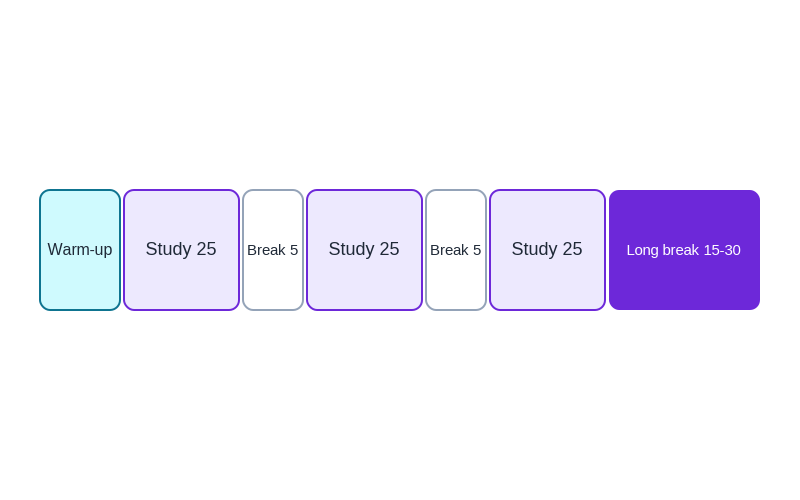
Start with 25 minutes of work and 5 minutes of break. It is the tested default, and every guide agrees on it. Change the length only for a clear reason, using the options below.
| Pattern | Work | Break | When it fits |
|---|---|---|---|
| Classic | 25 minutes | 5 minutes, 15 to 30 after four | Default for term study and problem sets |
| Short start | 10 to 20 minutes | 3 to 5 minutes | First days, or tasks you keep avoiding |
| Dense material | 35 to 40 minutes | 10 to 15 minutes | Long readings with many new terms |
| Deep reading | 50 to 52 minutes | 15 to 17 minutes | Single long texts; from workplace studies, not student trials |
You can set time blocks for 10 minutes, 15 minutes, or 20 minutes if you will have any easier time with those shorter blocks. Shorter blocks also suit younger learners, who build up toward the standard 25 minutes with practice. Longer blocks suit sustained reading, but Oregon State warns students against them for study: long unbroken stretches invite distraction and delay the break that restores attention.
Two details matter more than the exact numbers. First, keep the ratio of work to rest. A 2025 review lists working variants from 35 minutes of work with 10-minute breaks up to 90 minutes with long rests. It even suggests 35-minute blocks with 10-minute breaks for dense material.
Second, a well-known workplace finding — a study from 2014 found that a 52-minute focus and 17-minute break is the perfect balance — comes from office work, not student learning. Treat it as an option for long reading days, not as the student default.
Plan the day in blocks, with slack. Schedule no more than 12 to 14 pomodoros for an 8-hour day and keep 2 to 4 spare blocks for tasks that run long. Count finished blocks per task type each evening. Your estimates should sharpen as the records grow.
What mistakes break the technique?
The most common mistake is answering messages mid-block. Each reply breaks the rule that a set pomodoro must ring. Write the thought down and keep going. The note will wait.
The second mistake is spending breaks on the phone. Feeds and chats keep attention aroused instead of resting it. Move, look far away, drink water, and return.
The third mistake is stretching blocks too far. Ninety minutes without a break feels productive while fatigue builds quietly. The 2023 comparison showed where that leads: longer self-chosen sessions with higher fatigue and lower concentration. Keep blocks short until focus across a full day proves stable.
The fourth mistake is rigid timing that breeds timer anxiety. The rigid timing structure may not suit all learning styles, and excessive reliance on timers might induce anxiety or reduce intrinsic motivation. If the bell starts to rule the study, switch to shorter blocks, drop the count for a day, or study without the timer and return tomorrow.
The fifth mistake is judging blocks by output. The trials show less fatigue and better focus, not more finished tasks. Judge a day by blocks completed with full attention, not by pages covered.
How do you use it for psychology terms?
Give each block one job: turn looked-up terms into remembered terms. Look up a term, save it to a named list, and drill that list inside the block. One list per block keeps attention on a closed set. Try five to ten terms per block: small enough to drill twice with recall checks between rounds.
Run the block as retrieval, not review. Read a definition once, close it, and test yourself from memory (active recall). Say the term aloud from its definition, then flip the check. Re-reading feels smooth and teaches little; recall feels hard and teaches much. End the block by marking which terms stay weak, and start the next block there.
Size lists for the games you will play. The Question game needs at least four words in a list, so build lists of four or more before a multiple-choice block. Smaller leftover tasks share one block: look up three terms, check pronunciations, and file each into its list.
Mix topics between blocks (interleaving). One block on memory terms, the next on conditioning terms, forces your brain to tell ideas apart. That effort pays off when questions mix topics too.
Spread sessions across days instead of cramming the night before. One block today plus one block in three days beats four blocks in one evening for the same list. Your marks tell you which lists need another block and which rest.
Start small on heavy days. When a chapter repels you, commit to a single 25-minute block on its first terms. Starting is the hardest part (procrastination), and one finished block often pulls a second after it. Use the word of the day as the warm-up: one term, a few minutes, at a time you choose, before the first full block.
Psychology World fits this routine because it already holds the material. It gives 23,944 psychology and psychotherapy terms with search inside definitions and study progress as Pro features. It runs three study games (Flashcard, Question and Typing) for iPhone and iPad. It also offers a word of the day: one term each day at a time the user chooses, off until turned on. Look up the block's terms, save them to a list, and drill that list one pomodoro at a time. The app is free to start with no ads for everyone.
Keep the terms from this post
Look them up in Psychology World, save them to a list and study them.
Frequently asked questions
How many pomodoros should you do in a day?
Plan 12 to 14 pomodoros for a full study day and keep 2 to 4 spare blocks for overruns. Most learners cannot hold full focus for eight hours, so stop when attention drops and count finished blocks instead of hours. Your records will show your real daily count as they grow.
Is 50 minutes of work with a 10-minute break better than 25 and 5?
No trialed 50 and 10 protocol was found in the sources read. The closest tested options are 52 minutes with a 17-minute break from a workplace study and 50 minutes with a 15-minute break listed in a 2025 review. Use 25 and 5 as the default, and try longer blocks only for single long readings.
What do you do when something interrupts a pomodoro?
Write the interruption down and keep working until the timer rings. Deal with the note in the break. If the interruption cannot wait, abandon the block and start a fresh pomodoro after it, since a broken block does not count.
Does the Pomodoro technique raise grades?
No trial in the sources read measured long-term grades. Trials measured short-term focus, fatigue, and motivation, with moderate to low certainty. Expect fresher study hours, and let recall practice inside each block carry the learning.
Is the Pomodoro technique good if you get distracted easily?
Many guides suggest starting shorter: try 10 to 20-minute blocks, one task per block, phone out of reach, and each distraction written down. If attention trouble affects daily life, talk to a doctor or a qualified professional as well as adjusting study setup.
What should you do on the breaks?
Stand, move, drink water, and rest your eyes from text. Avoid feeds and chats until the longer break. A break that rests attention returns more focus than a break that feeds it new input.
Sources
- Ogut (2025). Assessing the efficacy of the Pomodoro technique in enhancing anatomy lesson retention during study sessions: a scoping review.
- Cirillo. The Pomodoro Technique (official method site).
- Duke Academic Resource Center (2025). Pomodoro Technique.
- Oregon State Academic Success Center. Pomodoro Technique.
- Wikipedia contributors (2026). Pomodoro Technique.
- Todoist. The Pomodoro Technique.