Cognition
System 1 vs System 2 thinking: fast intuition, slow logic, and the test that sorts them
 Yusuf DemirciContent Writer at Psychology World
Published 27 Nov 2026 · 11 min read
On this page
Please note
Psychology World is an educational reference, not diagnosis or treatment. If you need help, talk to a doctor or a qualified professional.
System 1 thinks fast and System 2 thinks slow. System 1 recognizes a face, reads a billboard, and finishes the phrase "bread and" without effort. System 2 multiplies 17 by 24, fills in a tax form, and checks a logical argument step by step.
The psychologists Keith Stanovich and Richard West gave the two modes these names in 2000. Daniel Kahneman made them famous in his 2011 book Thinking, Fast and Slow. He shared the 2002 Nobel Prize in Economics for this work, and died in 2024 at 90. This article defines each system in Kahneman's own terms. It gives you the three-question test that tells them apart, corrects three myths that trap students, and shows how to use both systems when you study psychology terms.
- System 1 is fast, automatic, and effortless. System 2 is slow, deliberate, and effortful.
- The two are metaphors for modes of thought, not areas of the brain.
- A bat and a ball cost $1.10. The bat costs $1.00 more than the ball. The ball costs 5 cents, yet most people first answer 10 cents.
- System 2 is lazy and usually accepts what System 1 suggests.
- Knowing the right answer does not stop the wrong impression: measured lines still look different in the Müller-Lyer illusion.
Keep the terms from this post
Look them up in Psychology World, save them to a list and study them.

What each system does
Kahneman opens his first chapter with two demonstrations. You see a photo of an angry woman and know at once that she is angry and about to say something unkind. Then you face 17 × 24. You know you can solve it, but the answer does not come by itself. The first moment is System 1. The second is System 2.
His own definitions come from the first chapter of his book, excerpted in Scientific American:
System 1 operates automatically and quickly, with little or no effort and no sense of voluntary control.System 2 allocates attention to the effortful mental activities that demand it, including complex computations.| System 1 | System 2 | |
|---|---|---|
| Speed | Fast, automatic | Slow, deliberate |
| Effort | Little or none | Needs attention and work |
| Control | No sense of voluntary control | Feels like agency and choice |
| Examples | Detect hostility in a voice, answer 2 + 2, drive an empty road, find a strong chess move as a master | Fill in a tax form, compare two washing machines, park in a narrow space, compute 17 × 24 = 408 |
| Weakness | Jumps to conclusions, ignores logic and statistics | Slow, tiring, easily disrupted by distraction |
The table hides one detail worth keeping. Pupils dilate while System 2 works and return to normal size the moment the work ends, whether you found the answer or gave up. Effort shows in the body, not only in the mind.
The bat-and-ball test
Shane Frederick built a three-question test around this difference in 2005. He called it the Cognitive Reflection Test. It measures the ability to stop an intuitive answer and check it. Each item invites a wrong answer that springs to mind at once.
Try the first item before reading on. Answer fast, then check.
- A bat and a ball cost $1.10 in total. The bat costs $1.00 more than the ball. How much does the ball cost?
- If it takes 5 machines 5 minutes to make 5 widgets, how long would it take 100 machines to make 100 widgets?
- In a lake, a patch of lilies doubles in size every day. It covers the lake in 48 days. On which day does it cover half the lake?
The answers are 5 cents, 5 minutes, and day 47. The intuitive answers are 10 cents, 100 minutes, and day 24. The trap in the first item is exact: 10 cents feels right, but then the gap between $1.00 and 10 cents is only 90 cents, not $1.00. As Frederick writes, catching that error is the same as solving the problem, because nearly everyone who rejects 10 cents gives 5 cents.
The numbers behind the test are real. Frederick gave it to 3,428 respondents in 35 studies. The wrong answers 10, 100, and 24 dominated the errors. Even many people who answered correctly first thought of the wrong answer: margin notes show 10 cents crossed out next to 5 cents, never the reverse. People who missed the items also rated them as easier than people who solved them did.
One caution matters for students. By 2016 the test was so famous that over half of new participants had already seen at least one item, mostly through the media. Exposed participants scored 2.36 out of 3 against 1.48 for first-timers. Memorized answers measure exposure, not reflection. Use the test to feel the two systems pull in different directions, not as a score of ability. The full paper with all three items and the data repays a careful read.
How the two work together
The systems do not take turns. Both run whenever you are awake. System 1 runs on its own and keeps sending suggestions to System 2: impressions, intuitions, intentions, feelings. System 2 accepts most of them with little change. You believe your impressions and act on your desires, and usually that works well.
System 2 steps in when System 1 gets stuck. A surprise triggers it. A difficult question triggers it. The promise in the bat-and-ball item is that the check takes only a moment, and still most people skip it. System 2 is in charge of self-control, but it is lazy, and constant vigilance would be impossibly tedious. Kahneman's compromise is practical: learn which situations produce mistakes and try harder only when the stakes are high.
Two demonstrations show the partnership at work.
The invisible gorilla is the first. Viewers count basketball passes by one team and ignore the other. Halfway through, a person in a gorilla suit walks across the court, beats her chest, and leaves. She is visible for 9 seconds. About half of viewers never see her.
The counting task belongs to System 2, and it absorbs the attention System 1 needs to register the surprise. The lesson is double: we can be blind to the obvious, and blind to our blindness.
The Müller-Lyer illusion is the second. Two lines of equal length look different because of the fins attached to them. Once you measure them, your System 2 knows they match. Your System 1 still shows one line as longer. Knowledge does not switch off the percept. The only defense is a rule: mistrust your impression of finned lines, recognize the pattern, and apply what you measured.
Keep the terms from this post
Look them up in Psychology World, save them to a list and study them.
Three myths that trap students
Popular summaries distort the theory in three fixed ways. Each one appears in exam answers. Each one costs marks.
Myth 1: the two systems are brain areas
They are not. The left-brain versus right-brain story is false, and System 1 versus System 2 maps onto it no better. Kahneman states it plainly: there is no part of the brain that either of the systems would call home. Treat the names as nicknames for two agents in a story, the way you would treat Bob and Joe. The terms describe what thinking does, not where it lives.
Myth 2: System 1 goes first, then System 2 checks
The two systems work in tandem, not in sequence. Almost every act mixes both. Emotion from System 1 guides the reasoning of System 2, and deliberate practice calibrates the intuitions of System 1 over time. A chess master's instant move looks like pure System 1, but years of System 2 study built it. A careful argument looks like pure System 2, but System 1 chose which points felt worth making.
Myth 3: System 1 is biased and System 2 fixes it
Both systems make mistakes. System 1 can gather bad data that System 2 then processes correctly into a wrong conclusion. System 2 can take good data and rationalize it into what you already believed. Confirmation bias uses both: System 1 notices what fits your view, and System 2 analyzes new facts to defend it.
Kahneman called the idea that System 1 errs and System 2 corrects it ridiculous. System 1 usually works beautifully. It fails in specific situations, and the skill is recognizing those situations, not distrusting intuition as a whole.
The biases are System 1 shortcuts
Every cognitive bias in this blog's collection is a System 1 shortcut that skipped the System 2 check. Read this article first, then meet each shortcut by name.
The halo effect is System 1 letting one good trait color a whole person, the way a pleasant voice colors a job candidate. Anchoring bias is System 1 gripping the first number it sees. Confirmation bias is System 1 admitting friendly facts and System 2 defending them. Loss aversion is System 1 feeling a loss about twice as strongly as an equal gain. The availability and representativeness heuristics are System 1 judging by memory ease and by resemblance instead of by base rates. The full list of 25 biases collects them in one place, and the algorithm versus heuristic explainer shows when a shortcut beats a guaranteed method and when it does not.
Use both systems to study psychology terms
Studying uses the same partnership. Retrieval is System 1 work: fast recall of a term you drilled until it comes by itself. Elaboration is System 2 work: explaining why the term holds, in your own words. Most students spend all their time on input and never test the output. Flip the order.
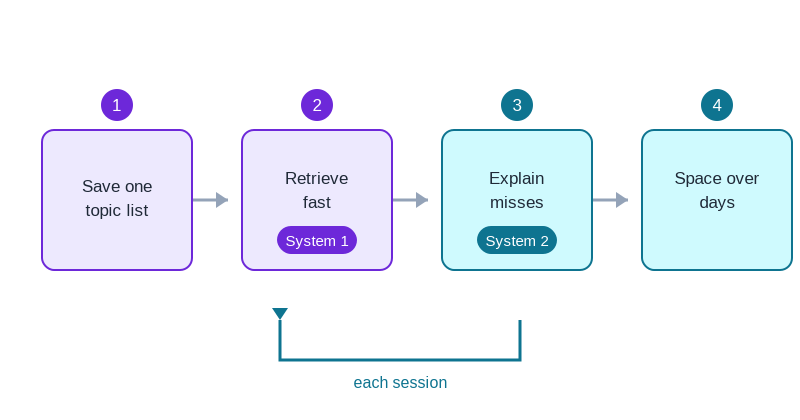
- Save the terms of one topic into one named list in Psychology World, for example alarm reaction, shock, countershock, resistance, exhaustion, eustress, and distress.
- Drill the list with flashcards first. One card, one answer, no peeking. That is System 1 training. The flashcard routine shows the setup: one question per card and misses sorted for review.
- Switch to the Question game once the list holds at least four words. Four options force System 2 to compare meanings instead of recognizing shapes.
- For every miss, say the definition aloud in your own words before moving on. That sentence is the System 2 check, the same move as rejecting 10 cents.
- Space the sessions over days. Spaced repetition beats cramming because each session retrieves the term again, and active recall beats re-reading for the same reason.
The product paragraph, as the blog rules require it: Psychology World holds 23,944 psychology and psychotherapy terms in a dictionary you can search, including inside definitions. It runs on iPhone and iPad. Bookmark lists hold your terms, with study progress marking each one New, Learning, or Known. The three study games are Flashcard, Question, and Typing. Search inside definitions and study progress are Pro features. The word of the day brings one term each day at a time you choose, and it stays off until you turn it on.
The one-question test
Sort any example with one question. Did the answer arrive before you chose to think?
Recognition, a gut feeling about a stranger, the 10 cents on the bat-and-ball item: the answer was already there when you noticed it. That is System 1. Long division, comparing two phones feature by feature, checking whether the fins explain the line lengths: nothing arrives until you work. That is System 2.
Mixed cases are normal. Reading mixes both, and so does driving a familiar road while watching for one exit. Name the dominant partner and move on.
Keep the terms from this post
Look them up in Psychology World, save them to a list and study them.
Frequently asked questions
Which system is better?
Neither. System 1 handles routine, familiar, and urgent moments with speed and little cost. System 2 handles new, complex, and high-stakes problems with care. Good judgment pairs them: fast pattern use, then deliberate checks where mistakes cost most.
Are System 1 and System 2 parts of the brain?
No. They are metaphors for two modes of thought, not brain areas. The full case is under Myth 1 above.
Can System 2 correct the mistakes of System 1?
Sometimes. It can reject 10 cents, distrust finned lines, and slow down a snap judgment. But System 2 is lazy, it misses errors it has no clue about, and it can rationalize a biased starting point. Both systems err. The defense is recognizing risky situations, not trusting one system over the other.
Do the two systems ever work at the same time?
Almost always. Nearly every mental act mixes both. Fast processes supply impressions and slow processes shape, check, and sometimes override them. Practice moves work from System 2 to System 1, which is how study turns effort into recall.
Is there a System 3?
No standard theory defines a System 3. A few writers propose extra systems for specific purposes, but exams and textbooks use two. Treat any System 3 you meet as one author's proposal, not established psychology.
How do I use this for exams?
Write the bat-and-ball item on a card and answer it cold before each study week. When a question feels easy, pause and ask what System 1 skipped: the base rate, the comparison group, the definition's second half. Then answer in your own words.
Sources
- Daniel Kahneman (2012). Of 2 Minds: How Fast and Slow Thinking Shape Perception and Choice, Scientific American, book excerpt.
- Shane Frederick (2005). Cognitive Reflection and Decision Making. Journal of Economic Perspectives, 19(4), 25-42.
- NobelPrize.org (2002). Daniel Kahneman, facts: prize motivation, share, life and work.
- Princeton University (2024). Daniel Kahneman, pioneering behavioral psychologist and Nobel laureate, dies at 90.
- Matthew Haigh (2016). Has the Standard Cognitive Reflection Test Become a Victim of Its Own Success? Advances in Cognitive Psychology, 12(3), 145-149.